

Technological innovation is transforming recruitment at breakneck speed and recruitment marketing automation (RMA) is playing a leading role in this. Our RMA Trends Report 2025 shows that automation, AI, talent pools and skill-based hiring are the main trends preoccupying recruitment professionals. What opportunities do these developments offer and how can organisations put them into practice? In this article, we dive deeper into the research data and find practical examples to future-proof your recruitment strategy.
Technology dominates recruitment trends
As our annual recruitment trends webinar already revealed, technological innovations play a major role in developments within recruitment. Three of the five key recruitment trends for 2025 relate directly to technology. Recruitment marketing automation (RMA) is one such technological innovation on the list of trends and has evolved over the past year from a buzzword to an indispensable part of any recruitment marketing strategy.
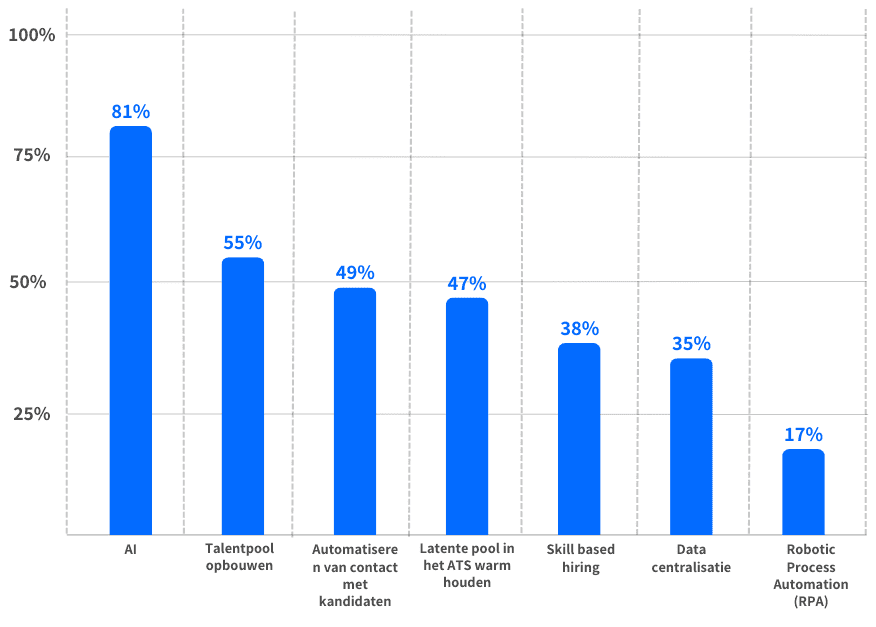
When asked "Which trends and developments related to RMA are you keeping a close eye on?" in our RMA Trends Survey, respondents answered with an overwhelming majority: AI. There is also a lot of interest in building talent pools and keeping latent candidates warm, plus automating candidate contact.
This is the full top 5 in RMA trends according to the RMA Trends Survey:
- AI
- Building talent pools
- Automating contact with candidates
- Keeping the latent pool warm in the ATS
- Skill-based hiring
Skill-based hiring also features in the top 5 trends. Due to the mismatch between supply and demand in the labour market, more and more employers are broadening their recruitment scope. Much can be learnt, and work experience or qualifications do not always determine whether you are suitable for a vacancy. Some employers are therefore starting to select candidates based on skills. In the RMA Trends Survey, 38 per cent of respondents indicated that they are following this development. The international report *The Work We Want* reveals similar figures regarding skills-based hiring.
The differences between organisational segments
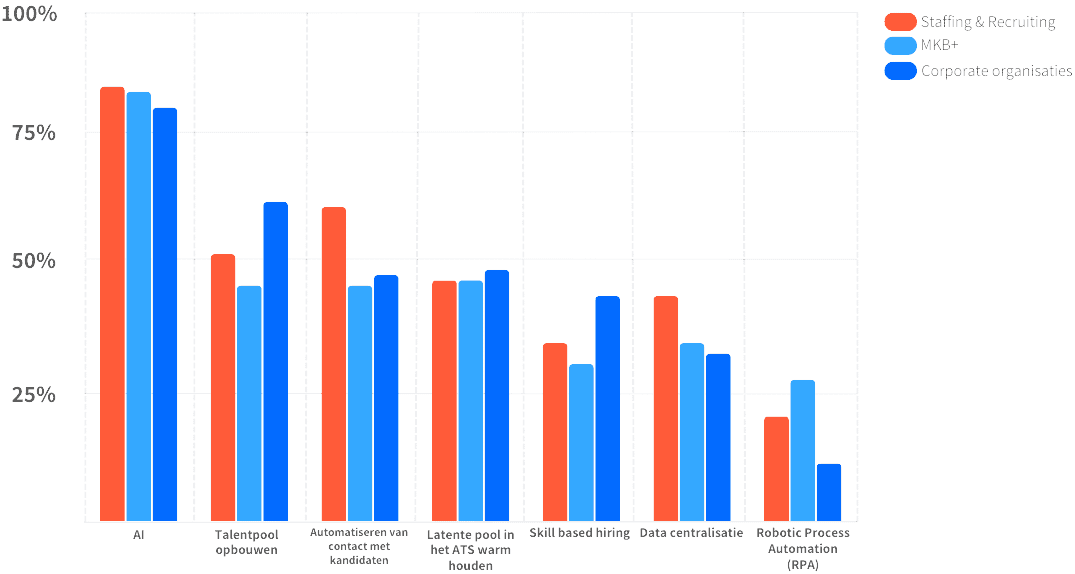
If we segment the results from the survey by organisational type (corporates, SMEs and recruitment agencies & staffing), we see that across all segments, AI is at the top spot. In the rest of the top we see small differences between the segments. Corporates are more interested in building talent pools, while recruitment agencies and staffing are mainly looking at opportunities to automate contact with candidates. Within SMEs, the numbers 2 to 4 in the top 5 are very close to each other.
The rise of recruitment marketing automation
Recruitment marketing automation is no longer just a trend talked about. Almost half of organisations are active with RMA. A third of organisations plan to deploy recruitment marketing automation.
Recruitment agencies and staffers lead the way here; more than half (54%) have fully or partially implemented RMA. Corporates struggle more with implementation. They indicate above average that they have plans, but have not yet taken any concrete steps.
In 2025, more organisations are turning these plans into action. 60% of respondents expect to invest more in RMA technology in 2025. A smart choice, because with RMA you can meet today's biggest challenges.
"This year we invested heavily in automation and recruitment marketing, which paid off: more than 80% of placements came through recruitment marketing channels." - respondent from the RMA Trends Survey
Currently, only 8% of organisations have fully embraced and implemented RMA across the candidate journey and it is paying off. In the RMA Trends Survey, we see that the average time to fill is 15 days among organisations that have fully implemented RMA, while it is 26 days among organisations where it is still unclear what RMA entails. A big difference!
RMA trends in practice: inspiring examples
Trends become valuable when you apply them smartly in daily practice. We highlight some employers that illustrate how you can benefit by capitalising on these new opportunities and developments.
Wortell: AI as an engine for recruitment growth
Over the past six years, IT services provider Wortell has grown from 120 to over 500 employees, despite the tight labour market and their significant recruitment needs in the IT sector. They have fully embraced the opportunities offered by technology, including AI.

"We are working towards an AI-first recruitment strategy. For example, we had AI bots do the concept development for content in our employer branding campaign and I created a custom GPT that allows us to automatically create job layouts with very specific information." - Friso Visser, Lead Recruitment Marketer Benelux at Wortell
Read our AI recruitment guide for more ideas on the applications of AI for recruitment.
Axians gets to know talent with gaming
ICT service provider Axians understands that, as a starter in the job market, you don't yet know exactly what you want or which employer suits you. They have therefore developed a creative way to help talent choose: an advice based on your game behaviour.
With psychologists, traits and skills are linked to the games the target audience plays and what they excel at. By letting candidates play games at events, such as career fairs, and asking them during the selection process which games they like to play, Axians can use a personal and unique game profile to support these candidates in their search process and thus retain them. In other words: Test your game skills and find your talent!
Faster recruitment process with automations in candidate contact
By partially automating the contact with candidates, you realise a faster recruitment process. This is nice for both candidates and recruiters. Candidates immediately know where they stand, while recruiters can focus on the best responses. Win-win!
For example, a recruitment agency in our client base uses automation to carry out the initial screening of candidates. This automated qualification process ensures that recruiters only interview relevant candidates, saving 90% of the time at this stage of the recruitment process!
Thom Oudhuis, a recruitment marketer at De Selectie who is currently on secondment at Securitas Technology, is also enthusiastic about the (partial) automation of candidate contact. They use automation to check whether candidates have the right language skills and to match them with the right recruiter. This removes a manual step from the process and speeds up the initial phase of contact.
From CV to skills: recruitment with a broader view
Skill-based hiring takes various forms. From an ‘open hiring’ strategy – whereby anyone who is interested is hired – to doing away with job vacancies and CVs altogether, as the healthcare organisation ‘s Heeren Loo does.

"Our target audience doesn't sit much at a computer. They are at the bedside or in the group and see our content pass by quickly. A CV is not at hand then, let alone a cover letter. Thanks to our new recruitment method, those documents are no longer the first impression. For many candidates, this has a huge impact on their threshold." - Deborah Hempenius, communications advisor HR and labour market communication at 's Heeren Loo
The future of recruitment? More tech and more personalisation
A clear common thread emerged from the final open-ended question on the future of recruitment in the RMA Trends Survey. Software and tooling can no longer be ignored in the work of recruitment professionals, but it is and remains a human profession. A job that is all about real connection. Our respondents see technology as a means to achieve their recruitment ambitions, not as an end in itself.
Some responses to this question in the survey:
- "We need to start using AI in such a sophisticated way that it feels personal".
- "Automation with a personal touch is the trend. Personal contact and real connection is becoming more important. Automation allows you to connect with the right candidate."
- "I see a transformation in recruitment where we go from doing a lot of candidate searches to building a personal connection with candidates."
Want to find out more about the key recruitment challenges and opportunities? Read the RMA Trends Report!