

At the end of last year, we traditionally looked at the key trends for 2024. This year, there is a lot of focus on improving efficiency and the candidate experience. But how do you actually implement these? Because trends an sich are nice, but without the translation into practice, they are of little use. That is why Mees recently explained in a webinar how to apply the 5 most important trends and boost your recruitment success. Read this blog for the webinar summary!
The 5 key trends in recruitment for 2024
Based on conversations with industry experts, desk research and input from our customers, we have drawn up the 5 most important recruitment trends for 2024. Top of the list is AI, followed by vacancy-free recruiting and skill-based hiring, data centralisation, robotic process automation (RPA) and the optimisation of the candidate experience.
There is a clear common thread in these trends: a focus on efficiency and candidate experience. Read on if you are curious to know how you can make your recruitment more efficient and offer candidates an unforgettable experience throughout the process!
Applications of recruitment trends
Trend 1: AI
AI is a hot topic in the world of recruitment: the opportunities are there for the taking, AI tools are mushrooming and developments are happening fast. Can't see the wood for the trees? Start applying AI in recruitment with these 3 simple steps.
1. Divide the candidate journey into stages.
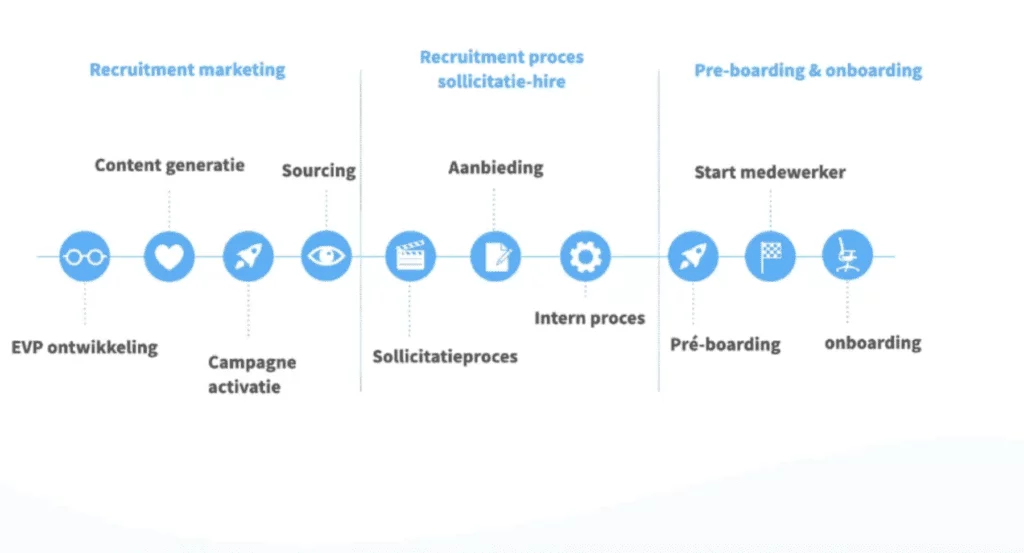
Make all touchpoints with the candidate transparent. From drafting the EVP to the actual onboarding and everything in between. You will probably arrive at 3 main phases, namely recruitment marketing, the application process and pre- and onboarding, with various components underneath, such as content generation, campaign activation and pre-boarding.
2. Make an overview of possible AI tools per phase.
Now you can decide which AI tools can support you in each phase. Especially in the field of content creation, you have a wide choice. Think of Kapwing for faster editing and subtitling of videos and Canva for creating appealing visuals. ChatGPT should certainly not be missing from your list, because it can add value in many areas!
3. Start simple.
Keep it simple and manageable by starting slowly. ChatGPT is a logical starting point, as this well-known AI tool currently offers the most and best functionalities. The free version of ChatGPT still leaves something to be desired, but with a paid account you can really make metres. For instance, you can build a custom GPT that lets you write customised job texts. In the right style and form. Fully automatically!
Trend 2: Vacancy-free recruiting and skill-based hiring
The transformation to recruiting without defined vacancies and selecting on skills instead of education and experience is the future. This way, the selection process becomes more objective, you get a wider range of talent in your organisation and turnover decreases because a better match is made. Care organisation 's Heeren Loo made this turnaround in recruitment strategy in 2023 and is already reaping the benefits!
Such a fundamental change in the way you recruit cannot be achieved 1-2-3. It takes time and internal coordination. These 3 steps offer a good guideline for the transformation to skill-based hiring:
1. Map internal skills.
What skills do you already have in your organisation? What skills do the most successful employees possess? With assessment tooling, you gain insight into the skills you have and that are needed in teams and for specific roles. That is your starting point.
2. Define the skills needed per function.
Then you can identify which skills someone needs in a job and which skills are a great addition to the team.
3. Implement tooling and processes.
Finally, you need tooling and processes that help you uncover applicant skills. Think of parties like Equalture and TestGorilla. Crucial to this way of recruiting is providing a low-threshold contact opportunity. Most candidates are not immediately willing to invest an hour or more to have their skills tested. The first step is non-committal contact and you can achieve that with lead generation tooling. With automated qualification questions, you can make a quick sift between candidates in the first phase and then only offer the suitable ones an assessment.
Trend 3: Data centralisation
The saying 'knowledge is power' is not out of the blue. Data allows you to gather insights, which then lead to smart actions and optimisations. To get started with data centralisation in your recruitment strategy, you can follow the following 3 steps.
1.Adapt to the cookie-less world.
To be able to collect data in the future, you need to switch to server-side tracking. A technical story, but in short, we can say that without server-side tracking, your campaign results will become extremely murky because you no longer store cookies. With server-side tracking, you place your 'own cookies', so to speak, and retain that important source of insight: data.
2. Bring data together in an app or dashboard.
Chances are you have an enormous amount of data, but that it is spread across all kinds of sources. Think of your ATS, social advertising accounts, job boards, Google Analytics. Only when you link this data and bring it together in a single dashboard can you start gathering real insight. Useful tools for centralising data from various sources include PowerBI or Looker Studio.
3. Media mix and effort mix modelling.
Now that you have insight into all the data, you can see exactly what happens when you turn the knobs. For example, you can reallocate your recruitment budget across channels and immediately see the impact. That way, you make smarter choices!
Trend 4: Robotic Process Automation (RPA)
RPA uses bots to mimic human actions for administrative tasks. Within recruitment, you can use RPA in three ways.
1. Chatbots at the front end of the process
You can deploy (AI) chatbots prior to an application to help candidates make their choice or enable low-threshold applications. For example, chatsimple.ai is a fine tool that directs candidates to the right information on the website and answers questions based on AI, and Joboti is a well-known tool to let candidates apply via WhatsApp. We are probably going to see many new developments in this area in the near future.
2. Marketing automation
The term marketing automation is on the rise within recruitment, which is not surprising as it offers interesting opportunities. RMA allows you to add new candidates to your talent pools, for instance through automated campaigns and lead generation. RMA also allows you to make better use of your existing database by staying in touch with past applicants and re-engaging them with the organisation and, in time, perhaps a vacancy.
3. Bot as a buddy in the application process
Changing jobs is a life-changing event and applying for a job is not taken lightly by many people. So how nice is it when you have a buddy to guide you through the entire process and provide tips. We see several employers experimenting with such an application buddy in the form of a bot. Talmundo and Appical are well-known parties for using bots as buddies.
Trend 5: optimising the candidate experience
In the ongoing war for talent, you can no longer get away with a mediocre candidate experience. You want to provide every candidate with a top experience to avoid dropping out during the process and deterioration of your employer image. In this, 3 elements are crucial:
1. Fast follow-up
People are becoming increasingly impatient and accustomed to a quick response, even when responding to a vacancy. To realise this, you want to facilitate a large part of the application process online (so it can go on 24/7) and implement chat options for easy and quick contact. Here, you can opt for a (partly) automated response, so that a candidate is helped immediately and knows where they stand.
2. Gain trust
Overall trust in companies and agencies fell significantly during the corona crisis and did not fully recover afterwards. To overcome these challenges, it is important to be transparent about company culture and working conditions and offer an equal application process. That sawing through a candidate during an interview really can't happen anymore!
3. Pay attention to the total candidate experience, including onboarding
The candidate experience does not stop once a candidate has received an offer and signed the contract. Nobody forgets their first working day and the period between signing and their first month in service often determines whether someone actually stays on. A strong candidate experience therefore involves looking at the entire cycle. Each touchpoint gets the attention it deserves, so that every moment of contact with the employer delivers an outstanding experience.
Innovation as the key to success
Responding to trends and moving with the market and the wishes of your target group is one of the keys to recruitment success. Now and in the future. So start applying these trends and stay ahead as an employer!