
On TikTok, people swipe past adverts within a second. Spark Ads are the solution to this: you turn an existing, organic TikTok post into an advert, so that it still feels like content rather than an advert. In this blog, you’ll find out what Spark Ads are, how they work, what the pros and cons are, and when they could benefit your recruitment brand.
TLDR | TikTok Spark Ads turn an existing organic post into an advert, with your own profile, caption and engagement visible. This can be done with a post from your own business account, or with the permission of an employee, creator or ambassador via an authorisation code that applies to each video and for a specific period. Spark Ads feel like organic content, build lasting social proof and are often quicker and cheaper than creating new advertising material. On the other hand, you cannot edit the content afterwards, you are dependent on the creator and the duration of the authorisation, and a weak post will not improve simply because it is an advert. Spark Ads are particularly useful for employers who already post organically on TikTok and work best as a complement to regular sponsored posts, not as a replacement.
The problem: adverts on TikTok get swiped away
Candidates are increasingly looking for jobs in the places they already frequent, and TikTok is one of them. People use it to watch what they enjoy, not what they’re expected to see. A video that immediately looks like an advert gets swiped away within a second. Spark Ads solve this by making an advert look and feel like regular content. At MrWork , we use TikTok as part of recruitment campaigns, alongside channels such as Meta, LinkedIn and Snapchat.
What are Spark Ads?
Spark Ads are a type of TikTok advert that allows you to promote an existing organic post. This could be a video from the employer’s company account, or from a creator, employee or ambassador, provided they give their consent. The advert runs via TikTok Ads Manager, so you have all the options of a paid campaign: target audiences, budget, duration and measurable results. For recruitment, this means that a video in which a colleague talks about a typical working day reaches a wider audience, even beyond the company’s own followers.
How does it work in practice?
There are two scenarios. If the post is from the employer’s own TikTok account, you link that account to the advertising account and select the post in Ads Manager, without the need for any additional authorisation.
If the post is by someone else, an authorisation code is required. The creator enables ad authorisation for that specific video in the TikTok app, selects a validity period and generates a code. You enter this code in Ads Manager, after which that exact post can be used as an advert. Once the period expires, the advert stops automatically. If you wish to run the advert for longer, agree on an extension with the creator in advance.
When it comes to content created by employees, there are usually also issues relating to image rights and the GDPR. The TikTok authorisation code only governs advertising consent within the platform; it does not cover the underlying consent of the employee to appear recognisably in paid content. You should therefore establish in advance that a video may also be used as an advert, for what period and under what conditions. This is particularly important with a view to when someone leaves the company.
Spark Ads versus regular sponsored posts
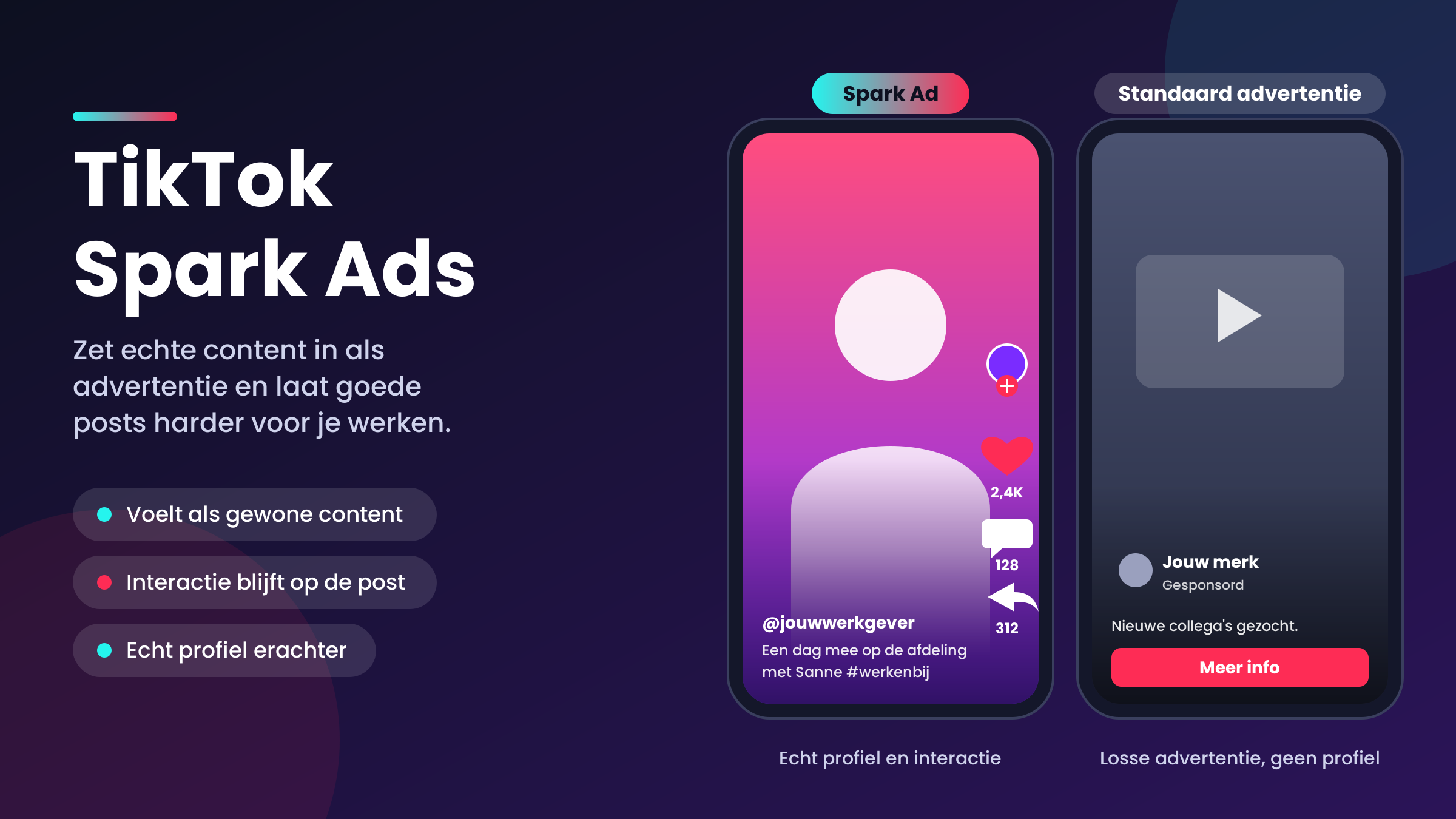
With standard sponsored posts – the standard In-Feed advert in Ads Manager – you create a video specifically for the campaign and publish it under a separate advert identity, distinct from an existing profile. That works well too, but differs from Spark Ads in a few ways:
A Spark Ad displays the real profile and the original post, complete with caption and engagement, making it less recognisable as an advert to the viewer than a standard advert: on a platform where people quickly swipe past adverts, that can make all the difference. The engagement works differently too. With a Spark Ad, likes, comments and shares remain on the original post, even after the campaign has ended, whereas with a standard advert, that engagement disappears as soon as the advert stops running.
Because a Spark Ad is linked to a real account, viewers can also click through to the profile and follow it, meaning potential customers will see the rest of the content too. With a standard advert that has its own identity, that profile doesn’t exist in the same way, so you don’t build a community with it. On the other hand, a standard advert does give you full control: you create a separate video, decide on the visuals, text and structure yourself, and can test different versions against each other. With Spark Ads, the video and caption are fixed because it’s an existing post, but this also saves you production time and costs and boosts a post that’s already performing well organically, rather than taking a gamble on a new creative that only proves its success after the campaign has ended.
Benefits of Spark Ads
Lower barrier to viewing. Because the profile, name and caption of the original post remain visible, the advert looks like content, not an advert. People are less likely to scroll past it.
Faster and cheaper. You don’t need to create separate advertising material, so you can act more quickly if something proves to be effective. This is particularly useful for job vacancies that need to be filled quickly.
Real stories reach a wider audience. A video of an employee talking about a typical working day is often more compelling than a polished corporate film. Spark Ads bring that story to a wider audience, without compromising the candidate experience.
Disadvantages of Spark Ads
You can no longer edit the content. The video and caption are fixed. If you want to change the message, you’ll have to do so in the post itself, and the engagement you’ve built up may no longer match the new version.
It depends on the creator. If the authorisation expires or someone withdraws it, the advert will stop. You need to agree on renewal in advance, and in the case of employees, you also need to consider what happens if someone leaves the company.
A budget won’t make a weak post any better. The quality of the original video remains the key factor in how well the advert performs.
More coordination is needed. Third-party content requires agreements on rights, remuneration and duration. That takes time, which a standard advert does not require.
Only with existing content. If you’re not yet posting organically on TikTok, there’s nothing to boost. A standard advert is therefore the more practical place to start.
Who might find Spark Ads useful?
Spark Ads are ideal for employers who already post organically on TikTok and want to get more out of it, for example with videos of colleagues or a behind-the-scenes look. They’re also ideal for brands that collaborate with creators or ambassadors, where the content remains recognisably from a real person thanks to the authorisation code. And they’re a logical choice as soon as an organic post suddenly gains a lot of attention: by investing a budget, you can build on that momentum rather than starting from scratch.
Frequently asked questions about TikTok Spark Ads
What is the difference between a Spark Ad and a standard TikTok advert?
A Spark Ad promotes an existing organic post using the original profile, caption and engagement. A standard In-Feed advert is newly created content under its own advert identity, separate from an existing account.
How do you request an authorisation code for a TikTok Spark Ad?
The video creator enables the advertising permission for that specific post in the TikTok app, selects a validity period and generates a code. You then enter that code into TikTok Ads Manager.
Are TikTok Spark Ads suitable for recruitment?
Yes, particularly for employers who already post videos of staff or the workplace on TikTok. Spark Ads increase the reach of that content amongst candidates who do not yet follow the company.
Do Spark Ads replace a standard advertising campaign?
No. Spark Ads are a complement, not a replacement. In practice, combining the two often works best.
Conclusion
Spark Ads combine the recognisability of a genuine TikTok post with the scalability and measurability of an advertising campaign. They do not replace standard sponsored posts, but complement them: a standard advert offers full control and scope for testing, whilst a Spark Ad excels in terms of credibility and engagement. In a recruitment campaign, the combination of both often works best.
Would you like to know whether Spark Ads are right for your recruitment campaign? Get in touch with us, and we’ll help you work through the options.