
Recruitment land is in flux and, according to the RMA Trends Report 2025, there is one opportunity in particular: talent pools. This potential goldmine is still little exploited, while the benefits are enormous. Less than 20% of organisations actively keep in touch with individuals in their talent pool and only 26% can actually draw on a talent pool when new vacancies arise. The good news? This is precisely where you can make a difference in 2025. In this article, we show you why talent pools are a game-changer and how to build and maintain them effectively. Time to dive in!
Talent pools as the recruitment opportunity of 2025
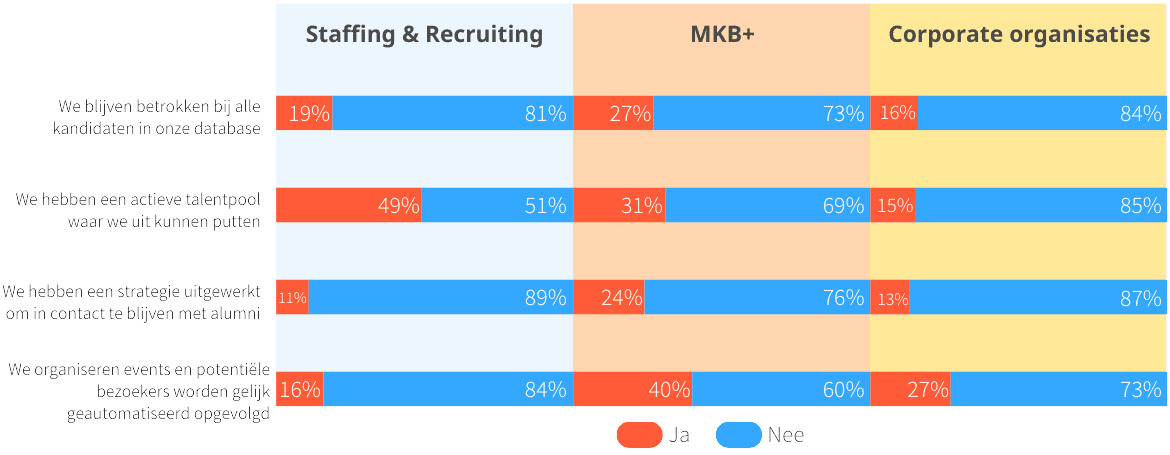
The RMA Trends Report paints a clear picture: most organisations have the basics in place. The jobsite and ATS system are in place (67%) and recruitment processes are being scrutinised and optimised (66%). But opportunities remain in the area of contact with candidates and talent pools:
- Active contact: Less than 20% of organisations stay in active contact with candidates in their database.
- Use of talent pools: Only 26% have an active talent pool that is utilised for new vacancies.
- Automation: Automations are mainly used for administrative tasks, while only a quarter use them to interact with talent.
The ambition to build talent pools is there, but there is often a lack of strategy and resources to do this efficiently. And yet building good relationships with candidates can deliver so much!
For the following statements, please indicate whether or not they apply within your organisation:
The impact of talent pools on your recruitment success
Why are talent pools so valuable? Because they allow you to activate latent candidates. Through nurturing campaigns, you build a relationship with talent that is not (yet) ready to switch employers. As soon as they do start considering it, they will think of your organisation first. Even before competitors know at all that they have a job switch in mind. In this way, a well-maintained talent pool helps you to:
1. Reduce time-to-fill: You already know candidates who fall within your target group and have built a rapport with them, which means you can switch immediately when vacancies arise. This is clear from the RMA Trends Survey: respondents who say they don't have a good way of building and maintaining talent pools have an average time-to-fill of almost 27 days, while respondents who don't see this as a challenge need only 21.2 days to get from job application to signed contract.
2. Lower the cost-per-hire: You've already done the job of attracting candidates when filling your talent pools. So you don't need to reinvest time and money in recruitment campaigns and sourcing to fill your pipeline.
Talent pools therefore allow you to add a highly effective and efficient method to your recruitment strategy, thereby increasing your success. And recruitment success can enable further growth for the organisation. The Bullhorn GRID report shows that nearly half of the organisations investing in technology to boost candidate engagement have seen an increase in turnover over the past year.
Get started with talent pools
A talent pool is more than a database; it is a living ecosystem. Here are the three crucial steps to make the most of it.
1. Filling your talent pool: where to start?
To build a strong talent pool, you first need to attract talents. Here are some effective methods:
- Lead generation: Use social media advertising to reach both active and latent candidates and activate them to get in touch.
- Silver medalists: Candidates who just missed out on previous applications are often valuable additions. Perhaps a future vacancy will be right up their street!
- Alumni: Former employees already have a strong connection with your organisation. If their job ambitions or wishes change in the future, they might come back to you.
- Referrals: Candidates proposed by your own employees are often a good match and more intensively engaged with you as an employer.
- Events: Networking events and career fairs are perfect opportunities to connect with talent.
Indispensable in filling your talent pool is the use of soft conversions. These are low-threshold actions that candidates can take, such as signing up for a job alert, attending a webinar or scheduling an online cup of coffee. This way, you make it non-committal and easy for candidates to join your talent pool. From there, you can build on the contact. On to the next step!
2. Interact with candidates: build relationships
The success of your talent pool hinges on engagement. Candidates want to hear from you regularly. Bullhorn’s GRID report shows that 43 per cent want to be contacted at least once a week and that candidates who are in weekly contact with the recruiter are highly loyal.
You can use nurturing campaigns to create periodic contact moments. Simply put, these are automated contact moments that occur after a certain time period or by a specific trigger. Via e-mail, SMS and/or WhatsApp, you share valuable content with the talents in your database. Think, for instance, of an infographic on market developments, practical tips for improving a LinkedIn profile, or an invitation to a professional webinar. Because the candidate regularly hears from you as an employer and gets to know you, a stronger bond is created between the organisation and the candidate.
Some tips for effective nurturing campaigns:
- Share content that adds value for your target audience. Don't fall into the trap of only sharing news items about your organisation or vacancies. If a candidate has little connection with the organisation, there will be insufficient interest in reading this organisational news and a candidate will quickly drop out. Instead, share content that helps your target group further, e.g. professional developments and career tips.
- Automate personal contact. Although you automate messages, it is important to make them as personalised as possible. You can do this by segmenting your talent pools, for instance by experience level, region and/or job type, and offering each segment relevant content of interest to them. By doing so, you show that it is not a 13-in-a-dozen message that goes to thousands of recipients.
- Seek interaction with candidates. Stay away from just sending messages, but try to engage in conversation. Ask candidates questions or organise informal meetings to exchange knowledge and experience. A strong relationship is built through good interaction.
More talent pools than you think
It is smart not to keep all (potential) candidates in one talent pool, but to create multiple talent pools. For example, you can set up talent pools by target group (students / starters / professionals) or job type. You can also keep alumni and referrals in a separate talent pool. The advantage of this is that you can use a different communication strategy for each talent pool via automations. This way, you are in constant dialogue with your target group, in a way that is tailored to their needs, without recruiters having to be actively involved.
3. Recruiters in charge of interest: time for action
The ultimate goal of talent pools? That you can draw candidates from them for vacancies when the time is right. So make sure you measure how candidates respond to your messages and set triggers that generate follow-up action.
An illustrative example: suppose you share an infographic on 'trends in IT' with your IT talent pool. Candidates who view this e-mail and/or click through to your website, you can offer a few days later a follow-up action, such as an invitation to a webinar. People from your talent pool who attended the webinar can be called by a recruiter after a week to ask what they thought of it. That gives you an entry point to further engage with the candidate about the work needs at hand.
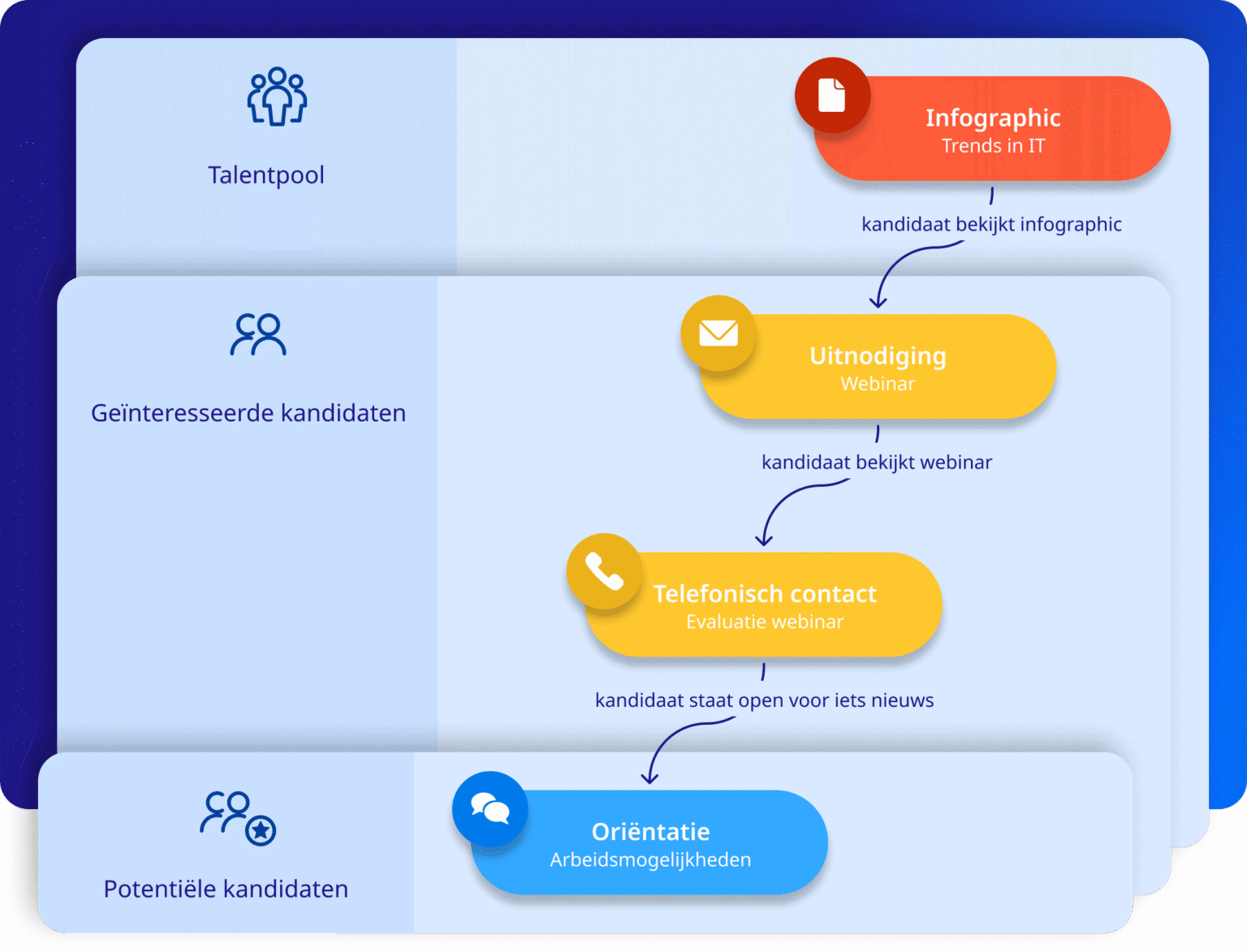
As soon as you notice interest emerging from a candidate in your talent pool, it is important for a recruiter to follow up on this contact. People still need personal contact and once they feel connected to you as an employer, they will be more likely to respond positively to a recruiter's invitation to have a chat. You don't want to miss that opportunity!
Seize the opportunity and harness the power of talent pools
Talent pools are the recruitment opportunity of 2025. They save time, reduce costs and increase your clout in a competitive labour market. But success lies in building, maintaining and activating these pools. By deploying technology and automation smartly, you can turn talent pools into a powerful tool to achieve your recruitment goals.
Ready to get started? Begin building your talent pool with our smart RMA technology and make 2025 your most successful year for recruitment!
Want to find out more about the key recruitment developments and trends? Read the RMA Trends Report!