

Candidates still have a choice in the job market, which means employers and recruitment agencies need to keep sharpening their strategies to attract talent. Where are the sticking points? And more importantly, what can you do to tackle these challenges? In this deep dive of the RMA Trends Report, you will get answers to that question!
Top 3 recruitment challenges for 2025
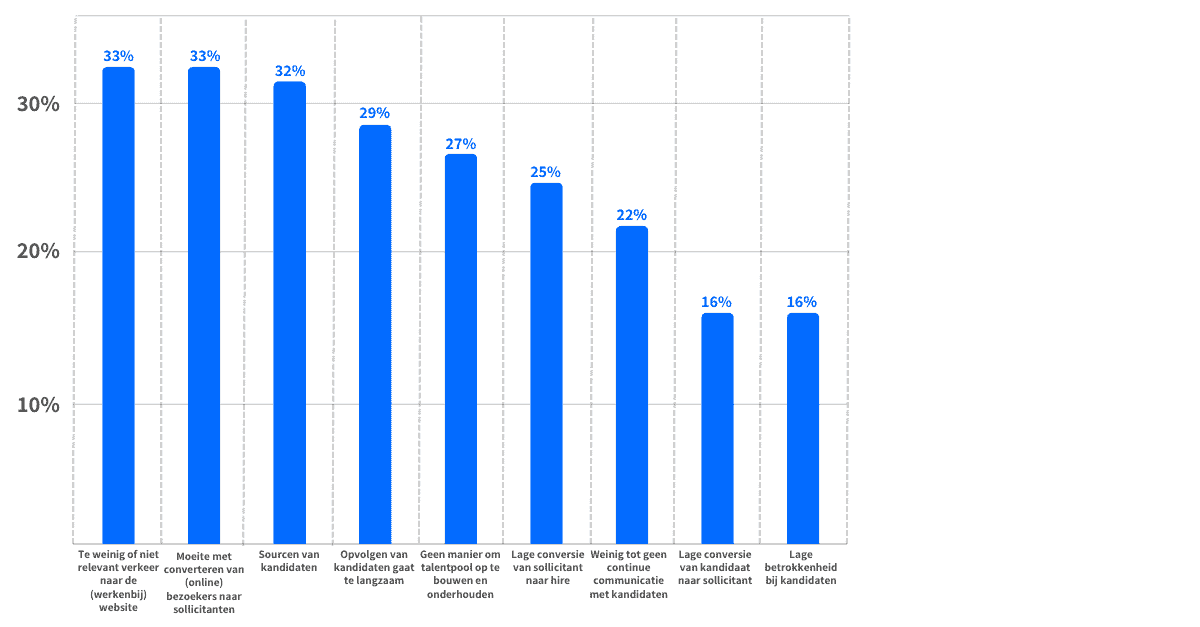
The recruitment process consists of many stages. It starts with reaching the target audience and ends with the hiring and onboarding of a new employee. Each phase has its challenges, but the RMA Trends Survey clearly shows where the shoe pinches the most right now:
- Too little (relevant) traffic on recruitment site (33%)
- Visitors do not convert enough to applicants (33%)
- Sourcing candidates (32%)
This top 3 is closely followed by challenges related to candidate contact and engagement. Indeed, at number 4 is 'candidate follow-up is too slow', followed by 'we have no way to build and maintain a talent pool'.
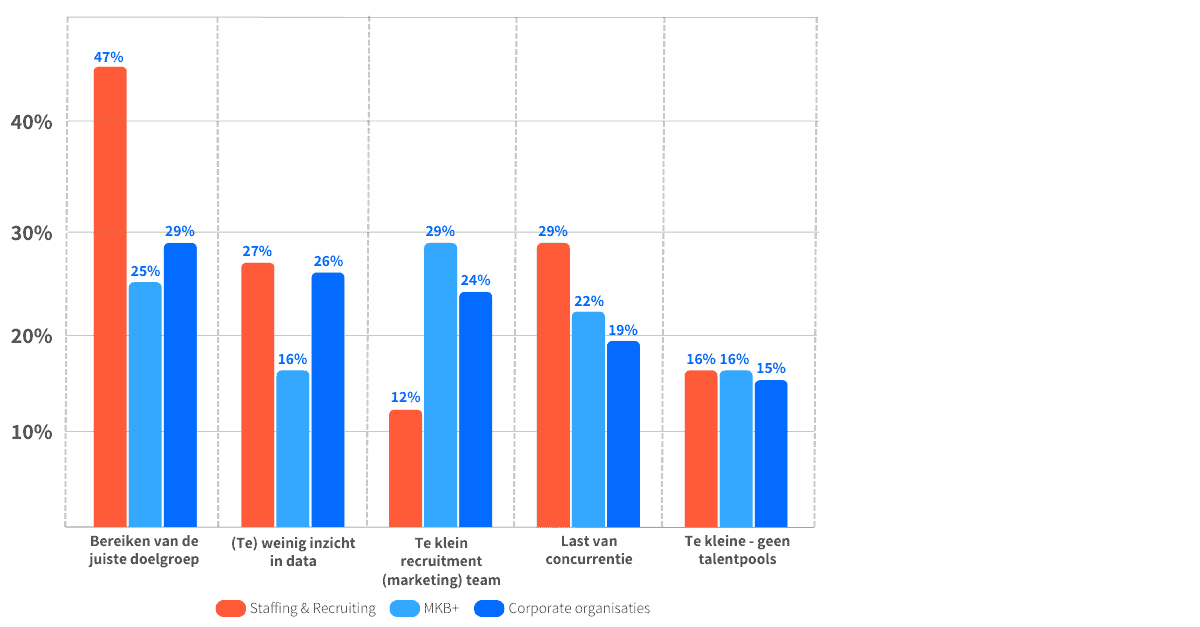
Slow candidate succession is especially an issue for corporate organisations (500 or more employees), as they most often cite this as a key challenge. SMEs and recruitment agencies and secondments are less affected. This could be explained by the fact that corporates often receive many responses from candidates due to their prominence and struggle to quickly filter and follow up on that volume of responses.
Increase your website traffic with smart recruitment campaigns
The first step in recruiting staff is to reach and engage your target audience. With a proliferation of media and advertising, the large pool of latent jobseekers (over 44 per cent by the end of 2024, according to the Intelligence Group) and competition amongst employers (106 vacancies for every 100 jobseekers), this is no longer as straightforward as it once was. The days of ‘post & pray’ are well and truly over. You’ll need to actively seek out your target audience and entice them to click through to your job site.
You can do this effectively with recruitment campaigns via channels such as LinkedIn, Meta, Google and other social media platforms. The best thing is if you can set up and manage these kinds of campaigns easily and quickly, so you remain flexible and get the most out of your advertising budget. You can do this with recruitment marketing automation software. Such a tool takes a lot of work off your hands, allowing you to set up and launch your campaign in just a few clicks. Keep those website visitors coming!
"Thanks to RMA software, our HR & recruitment team does not have to worry about the entire preliminary process in recruitment. We don't have to sourced ourselves or use other recruitment channels to bring in candidates. We get applications in thanks to our visibility with the campaigns we run through MrWork." - Sanne Schouten, HR adviser at Childcare Mundo

Increase candidate conversion with soft conversions
It is very likely that your ideal candidate has questions about the vacancy, finds applying for a job exciting or is too busy to fill in a comprehensive application form. The result? Talent drops out of your work-at-home site. This is a pity, because you have invested a lot of time and money to reach the candidate and attract him/her to your website. As soon as the website visitor clicks away your recruitment site, your momentum is over. Gone advertising budget and gone effort.
The average conversion rate for a careers site lies between 1% and 3%. The reasons why recruitment sites convert poorly vary, but the fact remains that with such a low conversion rate, a very large proportion of your visitors simply disappear into anonymity. Unless, that is, you can still entice these candidates to take a step in your direction. To do so, you need to make that step as accessible, easy and non-committal as possible. You need soft conversions!
A soft conversion is an action someone performs on your work-at-home site with the aim of getting in touch (long-term). This does not require a job application. Soft conversions include starting a WhatsApp conversation, creating a job alert, asking a question to a future colleague or registering for an event.
By offering soft conversions, taking action for a candidate suddenly doesn't feel so exciting and they can easily do it between business. You'll find that with this kind of lead generation method, you get far more responses than before. Where before you were happy with 3% conversion, with soft conversions this can easily go up to 10%. Once the first contact is made, you can build on that and it will regularly end up with a job application after all.
"We are much more in touch with potential candidates since we started working with lead generation tooling. In about 7 months, we have received more than 1,100 messages. Gigantic!" - Marieke Zwetsloot, Recruitment & Labour Market Communications Advisor at HMC

Go inbound sourcing with lead generation
Proactively approaching candidates is a widely used recruitment method, particularly amongst recruitment agencies and staffers, but its effectiveness is steadily declining. Sourcing pressure has long been above 40 per cent (Intelligence Group labour market figures) and response rates continue to fall, as candidates are inundated with messages from recruiters. There are various ways to increase your response rates – for example, by personalising your message extensively – but this takes an enormous amount of time, meaning that, for many sectors and job types, the results you achieve are not proportionate to the time you invest.
You can turn the tide. Not by relying more on outbound sourcing, but by getting candidates to come to you. You fix that with lead generation tooling. With these, you lower the threshold for responding - in response to a vacancy, advertisement or event - and get in touch with your target group much more often. If you increase the total conversion of your recruitment campaigns and your work-at-home site (hard conversion as in applying and soft conversion with lead generation) by a few percentage points, you will get so many more candidates that sourcing will be less or even unnecessary. So a big improvement in both efficiency and effectiveness!
Put tech at the heart of your recruitment strategy
The top 3 recruitment challenges can all be turned into opportunities by using innovative technology. This will make reaching and converting your target group easier and more successful and you will need less sourcing to fill your recruitment funnel. Three times win!
Want to find out more about the key recruitment developments and trends? Read the RMA Trends Report! Or get straight to work on tackling your challenges by using recruitment marketing automation. We’d be happy to give you a tour of our platform.