
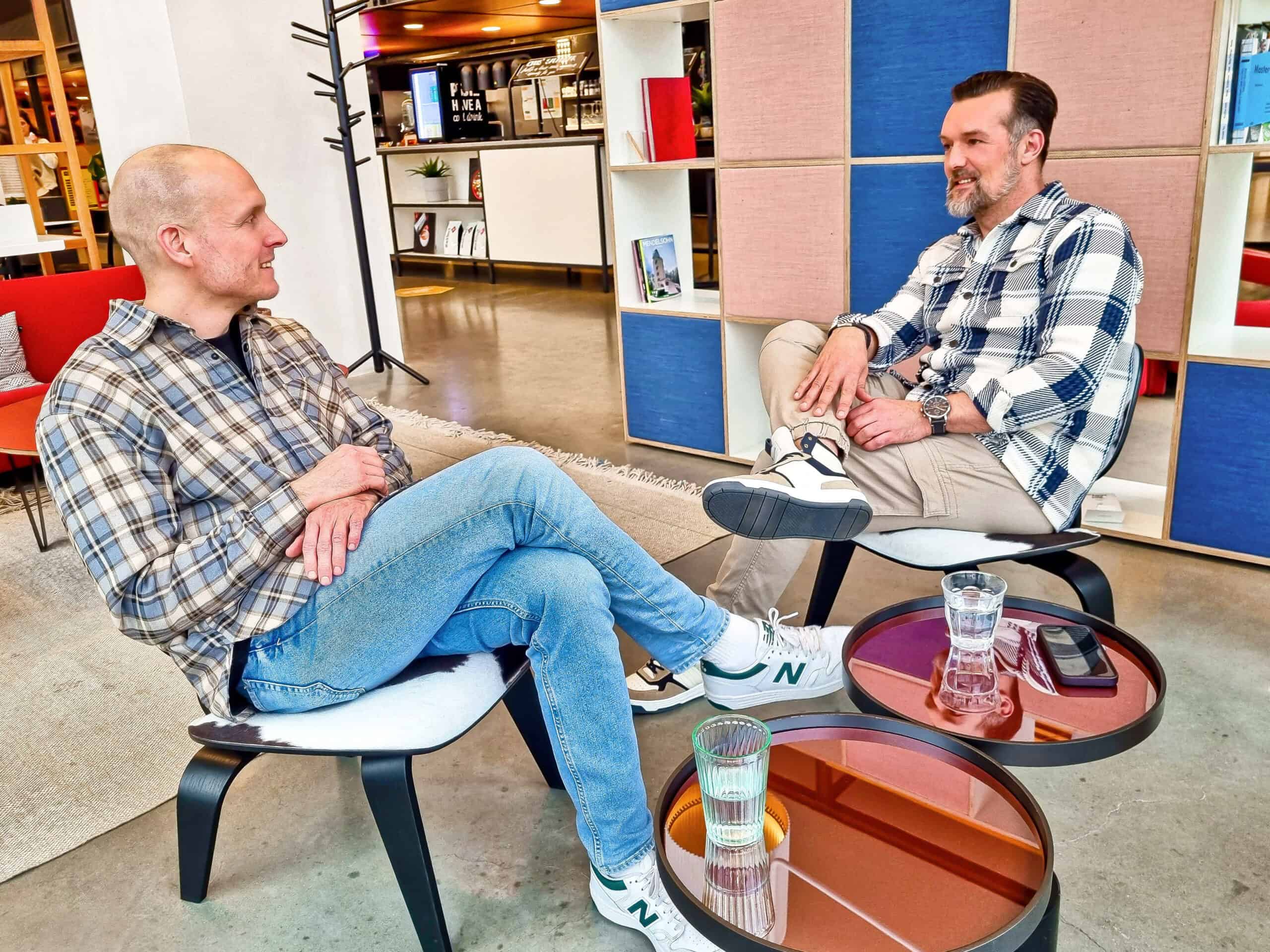
Successful employer branding requires two elements. The ‘soft side’, which centres on the employer’s narrative and associated creative content, and the ‘hard side’, where you use tools to activate your employer brand and distribute content to your target audience. Two worlds that, ideally, work together and reinforce each other, but in practice, one aspect is often overlooked. We spoke to Maarten Reeders, an independent employer branding consultant and photographer, and our very own Mees van Velzen, the leading expert on recruitment marketing software, to discover how you can bring these two worlds together to create a single, well-oiled employer branding machine.
Authenticity is key
When we ask Maarten and Mees about the key factors for a successful employer branding strategy, the term ‘authenticity’ quickly comes up. Maarten explains: “Strong employer branding tells the real story of your organisation as an employer. Who are you, what do you do, what drives you? And above all: what do you offer and promise? Candidates want to see the environment they’ll be working in and get an idea of who their future colleagues are. By painting a genuine picture of your organisation, you foster a sense of connection with your employer brand.”
Mees adds: "We also see this reflected in campaign results. A simple video in which a colleague armed with a smartphone asks some questions to team members often works better than a slick video in which everything has been thought out to perfection."
"This is why it doesn't work to just make up your employer brand in the boardroom or in the recruitment team. You should not think too lightly about this and instead involve the entire internal organisation. Indeed, as a company, you have an employer brand in advance. Because that is everything your employees and the market have long felt about you and how they express themselves about it. You can, however, strengthen it and influence it positively by capturing that emotion in your employer branding and sharing your authentic story," says Maarten.
Mees responds: "If what you convey in your employer branding does not match reality, candidates almost always notice. They drop out of the application process - causing recruiters to spend a lot of time on candidates who ultimately do not become a hire - or are gone again in their probationary period."
The paradox between AI and authenticity
The rapid developments in artificial intelligence are a hot topic in the recruitment world. Among other things, AI offers opportunities to organise content creation more quickly and easily. After all, you can use AI tools to generate images and videos and to write text. Mees explains: “Recently, Friso and I discussed the AI tool Sora on the Recruitment AI Weekly podcast. It allows you to create videos that are indistinguishable from the real thing, based on textual input. It remains to be seen just how effective such a tool is at present for creating a work environment featuring, for example, workwear with logos, but developments are happening so fast. That moment is very close, and once it arrives, such a tool could well take over ‘traditional visual creation’ using photography and videography.”
Only doesn't that come at the expense of the authenticity of your employer branding expressions? Maarten responds: "That's an interesting question. If you make a video with such a tool, for example, the image of the working environment in the video does not match reality. The same goes for the AI-generated people you see in the video. They don't exist in real life. So once a candidate goes for an interview with an employer, the actual image does not match what the candidate has been presented with. I think this is detrimental to your recruitment success. Don't get me wrong, for certain content it will work. I applaud AI developments and tooling and it's definitely going to complement and enlighten. But I don't yet see how it could completely replace the human touch in our work. It can, however, reinforce each other and thus go hand in hand, if you ask me."
Mees adds: "You can cheat with this as an employer, for example by showing a more diverse team in your videos than you actually have. That will certainly happen, but you can also look at it from the other side. It's not just employers who have access to AI tooling. I'm sure there will soon be all kinds of options for candidates to search for the best-suited employers for them based on various criteria. With 1 click, you will then get a list of employers that suit you. If you 'cheat' as an employer by painting an unfair picture, this will immediately backfire. This is because you will then get all kinds of responses from non-fitting candidates, which takes up a lot of your recruitment team's time. So to get the right people in, you have to be honest and tell the real story. So you could also argue that AI actually pushes employers to stay authentic in their employer branding."
Measuring the ROI of employer branding
There are other ways in which technology and employer branding are linked and reinforce each other. For instance, you see that many employers are aware that they need to do something with employer branding, but that it feels like an elusive concept.
Maarten talks about his experiences with clients: "What should we do? How does that work? How much capacity does it cost? And what does it yield? These are questions I regularly hear when I go to help a client with their employer branding. Especially the question about the ROI of employer branding arises in management and board teams. With technology, you can make it very clear what employer branding delivers. With MrWork 's recruitment marketing software, for example, you can immediately see what an employer branding campaign delivers. That makes the conversation with decision-makers and the preparation of realistic business cases easier, so that decisions are made faster."
A good example of strong employer branding, partly thanks to the use of technology, is Alliander’s campaign. Using recruitment marketing software, they spread their message, drive traffic to their careers site and attract applications. Thanks to technology, it is crystal clear to them what the campaign is delivering: increased brand awareness and popularity, as well as new candidates for their vacancies.
Let it run
Mees explains that for many employers, technology and employer branding do not yet work well together: "Employer branding is a 'soft subject', while technology and software are seen as 'hard'. These two facets are each in a different hemisphere of the brain, which makes it difficult to combine them. Many employers mainly focus on the soft side of the story and content or, on the contrary, the hard side of content distribution and software. While success lies precisely in the combination of both."
Maarten adds: "I also see this reflected in my assignments. Recruiters are mostly focused on sourcing candidates, filling the recruitment pipeline and filling vacancies. They are driven by these short-term results and are therefore soon too busy to engage in employer branding. Logical too in this tight labour market and the workload expected of them. Employer branding then gets left behind and that is a shame, because consistency is very important in employer branding. And recruiters often say they crave campaign and employer brand support. With recruitment marketing automation software, you still ensure continuous visibility with your target group and promote the employer story, because the software takes a lot of work off your hands. You can set everything up in advance and just let it run from then on. That way, the technology perfectly serves the employer branding activities."
A personal candidate journey for everyone
Mees sees another opportunity for employers to use tech for a stronger employer brand: "No matter how authentic and strong your employer branding content is, every individual has his or her own way of thinking, his or her own needs and therefore his or her own questions. If you deploy lead generation, you are very accessible to your target group and offer them the chance to connect and ask questions in an approachable way. This way, you can offer each candidate a personalised candidate journey tailored to what they want to know about your organisation."
You can then use nurturing to set up personal campaigns to strengthen the early relationship with potential candidates. You can send them very targeted updates or invite them to specialist webinars, because you are aware of their interests and have removed these people from anonymity early on with automation. So you can shape each candidate journey in the way that suits this particular candidate.
Technology and employer branding cannot exist without each other
With the rapid developments in AI, authenticity in employer branding will eventually be enforced. Technology makes employer branding tangible and measurable. Automations allow you to run employer branding campaigns without having to worry about it. Lead generation and nurturing take candidates out of anonymity and offer everyone a personalised candidate journey. These are all examples of how technology is inextricably linked to strong employer branding. Bring these two worlds together for a rock-solid employer brand and therefore greater recruitment success!