
MrWork speaks to and advises hundreds of companies every year about their recruitment marketing approach and ambitions. A recurring topic is invariably the creation of support within the company for the deployment of new technologies and ways to engage talent with your company and employer brand. In this series of three blog posts, we explain our learnings in a simple step-by-step plan to help you convince even the most conservative, traditional manager that it is time for innovation.
This step-by-step plan gives you a basis for making a business case for recruitment marketing solutions. In which you choose to load your employer brand and entice candidates with the right content, touchpoints and lead generation to come out of anonymity and join you. However, the roadmap can also be applied to convince stakeholders within your company to change or renew your recruitment strategy.
What does the roadmap look like?
There are three important steps in the step-by-step plan: first get the right data to crunch the numbers. Then you outline the disadvantages of the current approach and the possibilities of recruitment marketing(Alternative World). Finally, you combine steps 1 and 2 to arrive at the Return on Investment and also outline the Damage of Not Investing to indicate the risk of not investing(ROI & DONI). The roadmap then looks as follows:
- Step 1: Crunch the numbers
- Step 2: Alternative world
- Step 3: ROI & DONI
In the first part of this blog series, we will elaborate on step 1 of the step-by-step plan; "Crunch the numbers". Then the next steps will be covered in parts 2 and 3 of this blog series.
Step 1: Crunch the numbers
The crux of creating the business case for recruitment marketing starts with bringing the organisation into the numerical reality of the current recruitment strategy. Often the boardroom or management has a simplistic idea of how recruitment works within their company; hire enough recruiters, put a few agencies in place and your problem is fixed. This assumption misses many nuances that you, as a recruitment department, do have in focus. When making the business case, it is therefore essential to include the rest of the organisation in these insights.
Data framework
There is often a lot of data available, especially if you work in a large company, but it is less readily available. In addition, it is always a difficult task to choose the data that has the most impact for your argumentation. Of course, this depends heavily on your organisation. We have therefore chosen a simple framework with three elements. This gives you a good basis, is not too complex and is easy to communicate internally. Where possible, we have given benchmarks from MrWork's data.
- Sourcing funnel
- Website funnel
- Cost per hire
1. Sourcing funnel
It starts with understanding the activities of your recruitment department. Therefore, it is advisable to start with the question: what activities do we undertake for a candidate and how are these activities increasing? This allows you to make clear where efficiency gains can be made within your strategy. For this purpose, we distinguish between the following sourcing activities:
- How many messages do we send on LinkedIn?
- How many messages do we send on LinkedIn for a positive (!) response from a candidate?
- How many candidates are we cold-calling/emailing?
- How many job interviews result from these messages and calls?
- How many of these people will be hired?
- How many of these people are still working for our company after 24 months?
That translates to these 2 funnels for email/phone and LinkedIn:
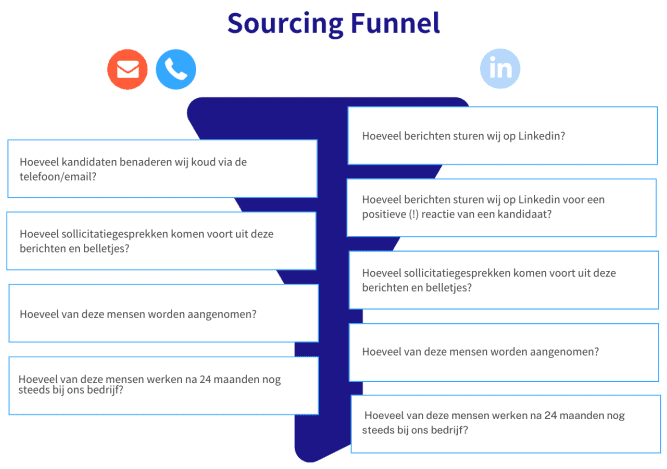
*The last question is relevant to make sense of the differences in quality of hires within the different ways candidates come in and go through the application process.
In addition, it is also relevant to map how much time is spent on this overall funnel. Once we have mapped this funnel, we can move on to the website funnel.
2. Website funnel
Besides your sourcing funnel and your cost per hire (CPH), you will also want to map out your funnel metrics when it comes to website conversions. To do this, we use a simple funnel that we measure over a period of time, usually the past year. In most cases, this is easy to find in the analytics of your website in combination with the data from your ATS:
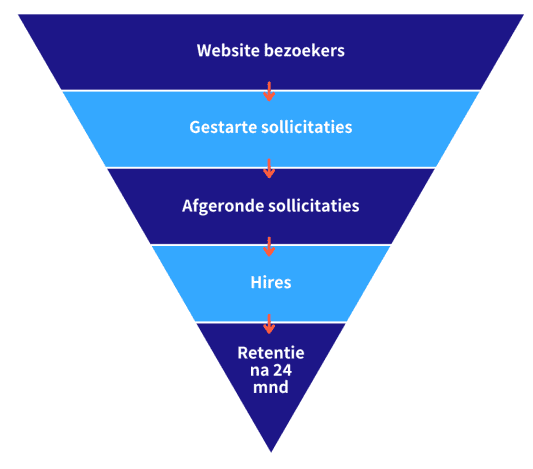
Again, it is advisable to also map out how much time your team spends on this process. Now that you have the sourcing and website funnels clear, you have an idea of the time spent and effectiveness of your internal recruitment apparatus. If these 2 funnels fall short, companies often choose agencies to fill the remaining positions. This comes at a high cost. The effective cost per person you hire, for both your internal and external recruitment, is mapped with the third step within the framework, the cost per hire.
3. Cost per hire (CPH)
CPH is not always easy to find out. In general, the bigger the company, the harder it is to get the right data. The following is not a watertight way of getting your CPH above water, but it does give you a good guideline on how to approach it. We distinguish between external and internal costs, so that you can later compare your ROI of both as well.
Elements of influence on your CPH:
- Staffing costs of your recruitment team
- Costs for agencies
- Recruitment marketing costs
- Costs for your technology stack (ATS, CRM, LinkedIn recruiter seats, onboarding software, etc.)
- Number of hires
But how do you calculate your CPH?
General formula for your CPH

Example:
- Sum staff costs = €250,000
- Agency costs = €300,000
- Marketing costs = €50,000
- Tech Stack = €25,000
- Total number of hires = 100
CPH then becomes: (€250,000 + €300,000 + €50,000 + €25,000) / 100 = €6,250
If you can uncover these costs, you can then also see what your CPH is for the various activities you deploy.
CPH agencies

*To calculate the cost of the tech stack for agency hires, we use the following formula: cost tech stack = total cost tech stack * % of total hires that came through an agency.
CPH sourcing

CPH website

*This includes things like hosting, periodic updates, etc.
Effective CPH
Now you have a picture of your total CPH and the CPH of your different activities. As a final step, we also want to know what the "waste" is within these CPHs. For this, we use the term "effective CPH". Someone you hire and then leave your company again after a short time is a huge hidden cost and creates extra work for your recruitment team. We do want to include these "mis-hires" in the CPH, because otherwise they lower your cost per hire, when the opposite is true. To show the effective CPH, we look at the CPH after 18 or 24 months:
Number of hires through agencies - Turnover of these hires after 24 months = Effective hires

Example:
- CPH = €10,000
- Total number of hires through agencies = 20
- Turnover within 24 months = 4
- Effective hires =16
Effective cost per hire then becomes: 10,000 * 20 / 16 = €12,500.
By calculating the sourcing funnel, the website funnel and the various effective CPHs, you will have a clear picture of the effectiveness and costs of your recruitment device. You know how much time your team spends on the various internal and external processes, you know how many hires these processes generate and what the retention of these hires is after a certain period of time. In the 3rd and final part of this blog series, we will return to these figures to calculate the ROI of your desired recruitment marketing strategy.
Want to read more?
Read Part 2, in which we provide you with tools to outline the benefits of recruitment marketing as a way of improving your recruitment strategy, based on social, technological and market developments.
Or read Part 3 of this blog series to find out how you can fill in the final piece of the jigsaw when it comes to building support by calculating the ROI of a recruitment marketing approach.
Free template 'Calculate CPH'?
Do you want to be able to calculate your cost per hire (CPH)? We have created a template that allows you to easily perform the above calculations for your organisation.
Download the template 'Calculate CPH
Do you want to be able to calculate your cost per hire (CPH)? We have created a template that allows you to easily perform the above calculations for your organisation.