

Do you want to attract and convince more candidates? Then individual recruitment ads are not enough. To really reach and activate them, you need to tell a story that takes them through the candidate journey step by step. That is exactly what you do with storylines: a series of ads that inspire, inform and activate your target group, at the right time and through the right channels. In this article, you will read how to use storylines to effectively tell your employer story.
Use storylines to tell your story
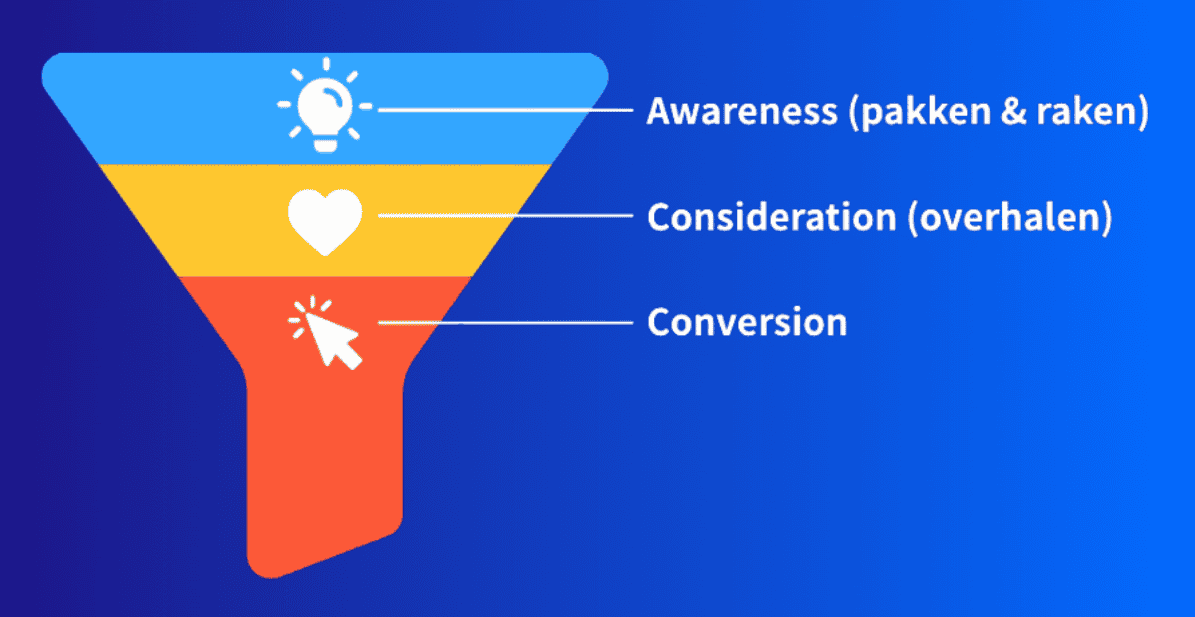
Most candidates do not decide one day to change jobs and start applying. It therefore works less well to just present your target audience with job ads. You will see that you attract more candidates if you start working with storylines. A storyline is actually a bundle of ads that are successively (as a story) shown to the target group. Within such a storyline, you respond to the phases in which candidates find themselves. Roughly speaking, we can distinguish three phases within the candidate journey:
- Awareness - the candidate gets to know you as an employer
- Consideration - the candidate becomes interested in you as an employer
- Conversion - the candidate takes action, e.g. applying for a job
Your target audience's needs are different at each stage. By creating ads for each phase, you always communicate the right message at the right time. This way, a candidate is fully included in your employer story. It starts with who you are and what you do and ends with concrete reasons to want to work for you.
Different content for each phase
It is not one size fits all when creating content. Each stage has its own characteristics and best practices.
Phase 1: Awareness
In this first phase of the candidate journey, you want to introduce candidates to the organisation. The message is still quite general. Think of ads about what you do and what your mission is. Video is often used in this phase, because it allows you to quickly create an image of the organisation. In the awareness phase, you do not yet incorporate a clear call-to-action (CTA) in the ads.
Phase 2: Consideration
Candidates are initially interested and therefore want to know more. In the consideration phase, you capitalise on this by sharing content about your working methods, projects recently completed, how teams work together and/or experiences of employees.
Advertisements in the consideration phase offer more information than in the awareness phase. Think (snippets of) interviews with employees, customer cases and subject matter blogs. If you use snippets (tip for social media ads!), you can link to the entire article or interview on the website as a CTA.
The aim of the consideration phase is to get candidates ready to take action. In short, you want to get them as excited as possible about working at your organisation!
Phase 3: Conversion
In the final stage, the CTA is central to your ad. You want to give candidates the final push to respond to a vacancy. A short and powerful message often works best here. For example, focus on the terms of employment of a vacancy to persuade the candidate to respond.
Choose the right channel
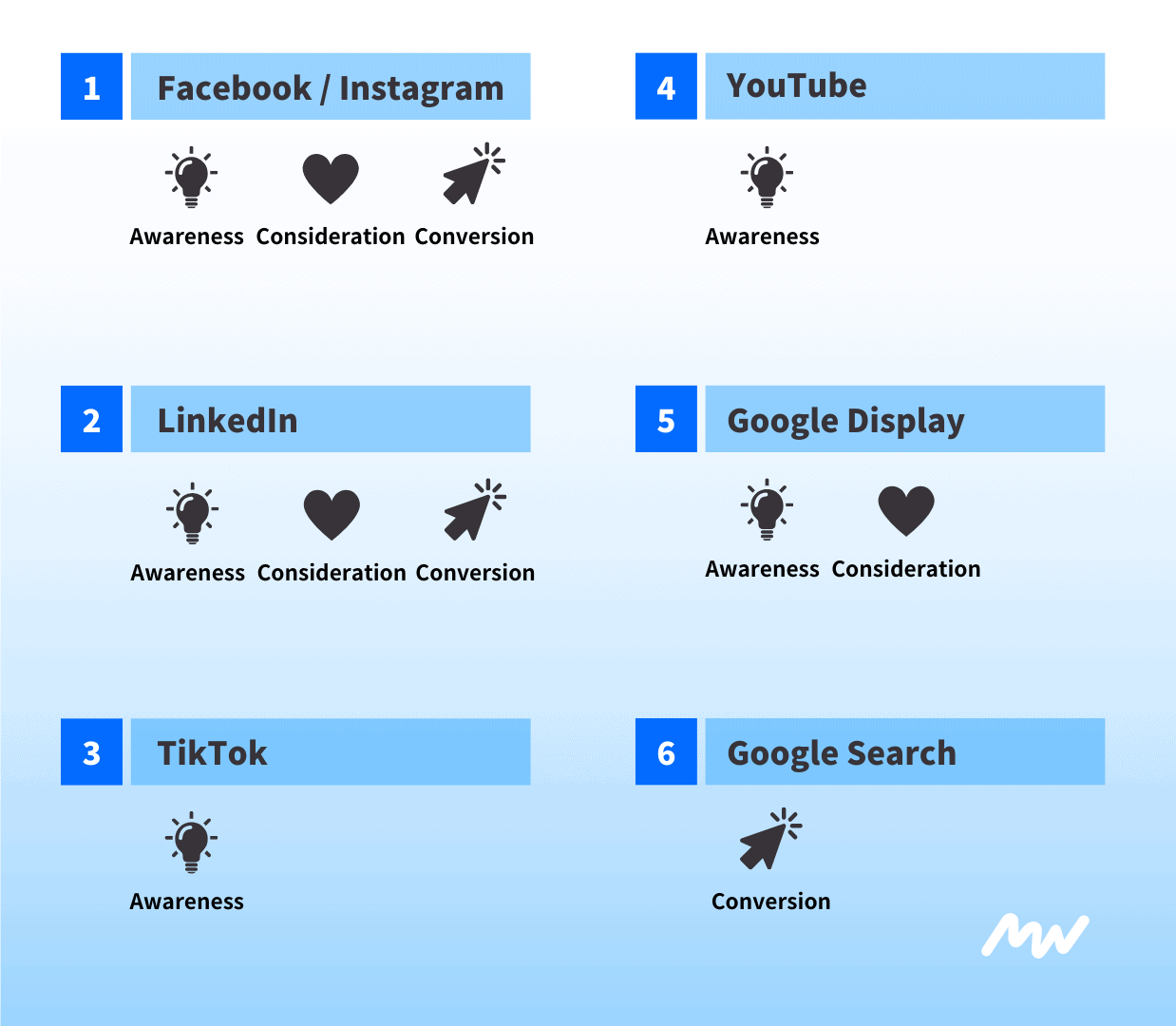
Now that you have built a complete storyline, it is time to choose the right channels to distribute these ads. Each channel has its own characteristics and therefore some are more suitable for conversion ads, for example, than others.
Linkedin, Facebook and Instagram are very well suited for each phase. You can also use Snapchat and TikTok very well in the awareness phase, especially if you want to reach the younger target group. If you want to address a broad target group with video in the awareness phase, YouTube is an interesting advertising channel. Google Search is best used in the conversion phase, because your target group will only see your ads within this platform if they actively google terms related to your organisation or vacancy.
Content tips per channel
Every channel is different, so it is smart to optimise your content for each specific channel. For instance, on one channel you can work well with video, while on another you can use text to convince your target group.
One general tip: if you work with video, don't forget the subtitles!
Facebook & Instagram
- Create both story ads (portrait visual) and timeline ads. (square or landscape visual)
- Keep your videos short and powerful. 15 seconds is a great length for a video ad on Facebook or Instagram.
- Experiment with various forms within your target audience, such as ads with an image and with video.
- A video may be slightly longer on Linkedin than on other platforms, as the attention span is generally a bit longer among Linkedin users.
TikTok
- Adapt the style to the younger target group.
- You can only add limited text, so make sure your video tells the story.
Youtube
- Trigger the viewer in the first 5 seconds to avoid skipping your ad as soon as you can.
- Make sure your (employer) brand is clear and recognisable in the picture.
Google Display
- Use many variations of text and images and find out what works best for your target audience.
- Do not use text in the visuals.
Google Search
- Incorporate important keywords of the target audience in your texts.
- Activate the viewer in your text to click through to your website.
Content cheat sheet
As different channels use different formats, it can be tricky to decide how to develop your content. For example, how long should the video be? And what is the correct aspect ratio for the images? Use our cheat sheet to see the specifications for each channel at a glance.