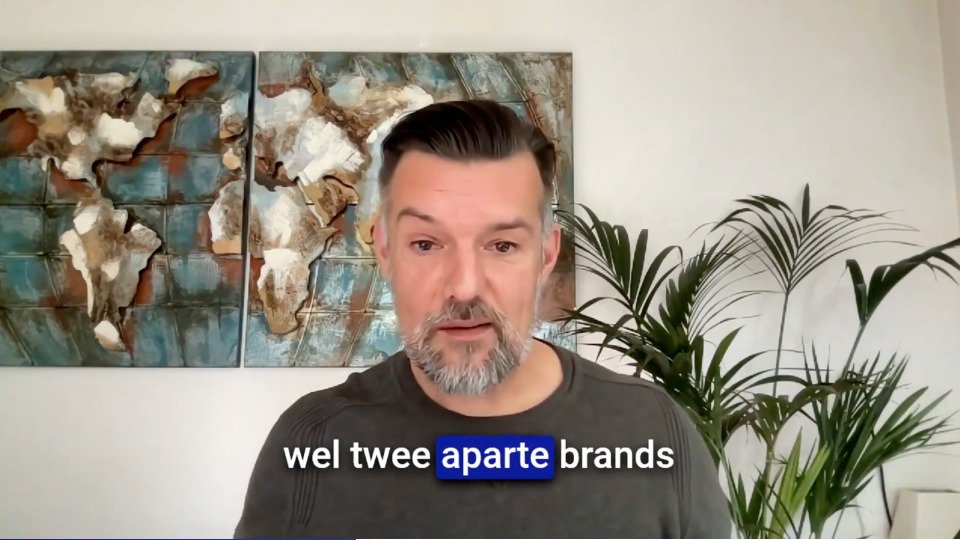
Employer branding is still an abstract concept for many organisations. Yet according to employer brand strategist and photographer Maarten Reeders, it is not a luxury, but a necessity. He helps companies, from large corporates to small start-ups, build an employer brand that is right and sticks. In this article, he shares his vision, experiences and tips.
You don't set up an employer brand, you already are one
According to Maarten, employer branding is all about honesty and genuineness. "It is your authentic employer promise. Or as I call it: you have to show your company soul." He is often asked by organisations to "just set up an employer brand", but he emphasises that every company has an employer brand from day one. It's what the labour market thinks of you if you don't listen in. The only question is whether and how you actively influence and use this brand to attract the right people.
A central role in that process is played by the Employer Value Proposition (EVP). He sees it as the foundation of your employer story: "An EVP is the summary of who you are as an organisation and what you promise to a potential colleague. It is the capstone from which you start working." To get there, he always starts internally: not with external campaigns, but with conversations with employees at all levels. Combining that input with external market analysis and reducing it to one powerful paragraph creates a solid foundation for all future communication. To avoid confusion: your employer brand is a substantial difference from your corporate brand. A classic pitfall is to confuse these with each other, although they can be mutually reinforcing.
Content that matches reality
Authenticity also applies to the content you share. Photography, video, blogs or even an employee managing the organisation's TikTok account for a day: it can all be valuable, as long as it is genuine. "Show your real employees, not actors. Candidates want to meet the people they will soon actually encounter on the shop floor."
Although video often has the most impact, especially on younger generations, Maarten always advocates a mix. Professional images give power and charisma, while more spontaneous snapshots or short videos emphasise approachability and authenticity. It does not always have to be perfectly produced; it is precisely this variety that makes an employer brand credible.
AI as a tool in recruitment
Technology is playing an increasing role in employer branding. From werkenbij-sites and ATS systems to AI tools that help to create content faster. Maarten sees AI primarily as a tool: "You can use AI perfectly well to write a first version of your EVP or to generate a first draft for your job ads, for instance. But the human touch remains indispensable, because authenticity cannot be automated." He also sees gamification and interactive content as valuable additions, provided they suit the target group.
Making employer branding measurable
Measuring success remains a challenge for many organisations. According to Reeders, employer branding is often a 'burner and not an earner' in the initial phase, because it requires a budget without the effects being immediately visible. Yet it delivers a lot in the long run. The real value lies in strengthening your employer branding and also in recruitment itself: "If you notice that your applicants not only become more, but more qualitative, your vacancies are filled faster and your turnover drops, then you see the real value and actual cost savings of employer branding."
Tip from Maarten: don't let your employer brand get snowed under
According to Maarten, cooperation between management, marketing and recruitment is essential for a strong employer brand. But he warns: "Don't let the corporate brand overshadow the employer brand." Where marketing and management sometimes think too much from the corporate brand, employer branding from recruitment requires its own place and strategy. "A customer makes a purchase, a candidate makes an essential career choice. That is a different need and requires a different story.