AI trends and developments in 2026
for staffing and recruitment agencies
Tech, tech, tech. For recruitment consultants at staffing and recruitment agencies, this has long since ceased to be an afterthought, but a pure necessity to keep growing. Even better: compared to corporates and SMEs+, agencies are visibly ahead when it comes to deploying AI and other recruitment software.
In the MrWork AI Trends Report 2026, we mapped how organisations are using AI today, where they see opportunities and what choices they are making. What immediately stands out: the priorities and plans of staffing and recruitment agencies differ from the overall picture in several ways. And precisely these differences say a lot about how this sector is developing.
In this report, we zoom in specifically on the numbers for staffing and recruitment agencies. What are they using AI most for? Where do they see the greatest added value? And what does this tech-minded strategy concretely deliver in terms of speed and results? This gives you a clear picture of where your organisation stands compared to other agencies and where there is still room to accelerate.
Key insights
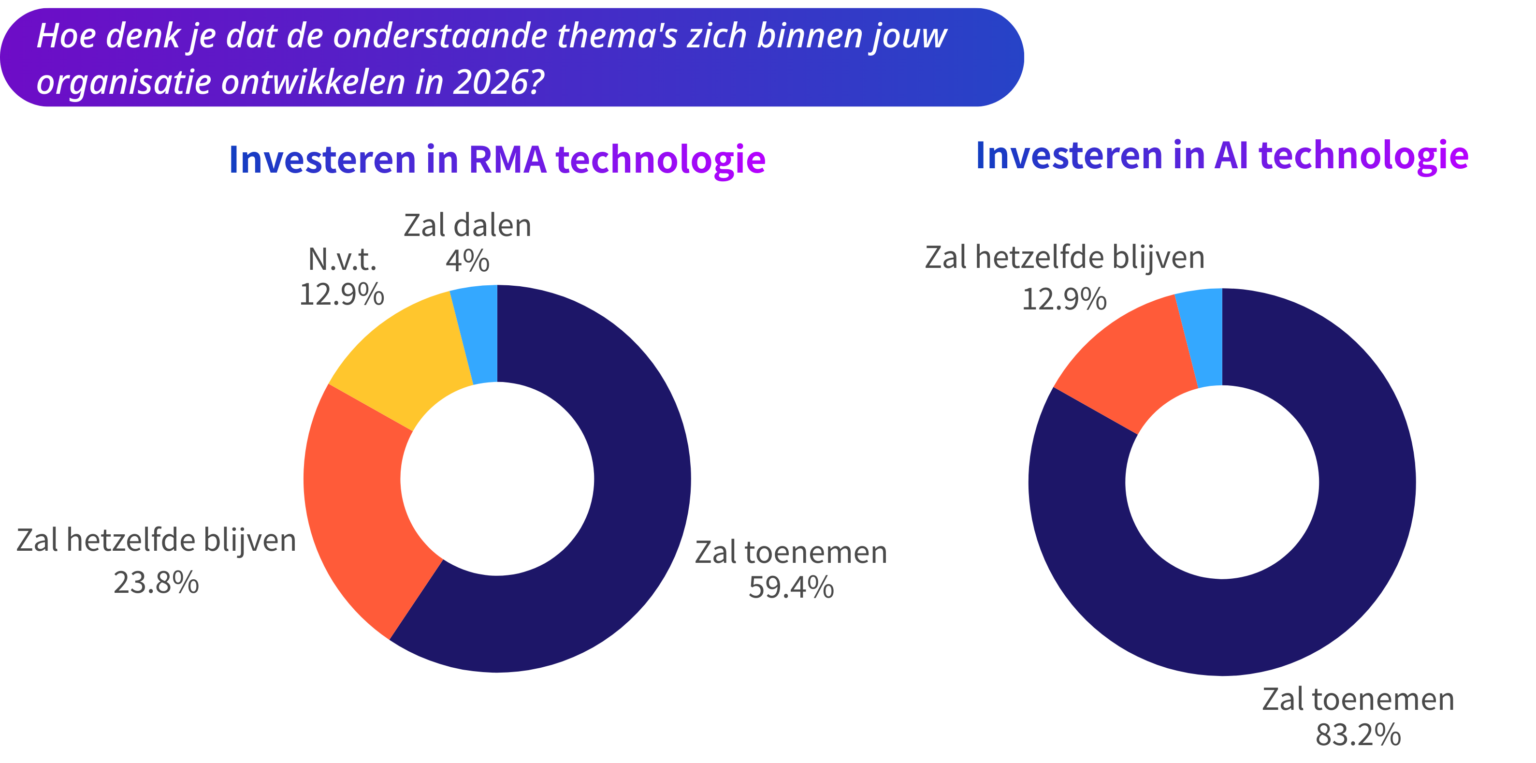
- Recruitment agencies and staffing organisations are tech leaders in recruitment. They deploy AI more often than recruiters at corporates and in SMEs+. That difference will only widen this year, with 84% in fact investing extra in AI tech in 2026. At corporates and SME+, the figures are 75% and 77% respectively.
- Recruitment consultants at agencies are using AI primarily for what drives revenue: finding and approaching candidates and optimising follow-up contact.
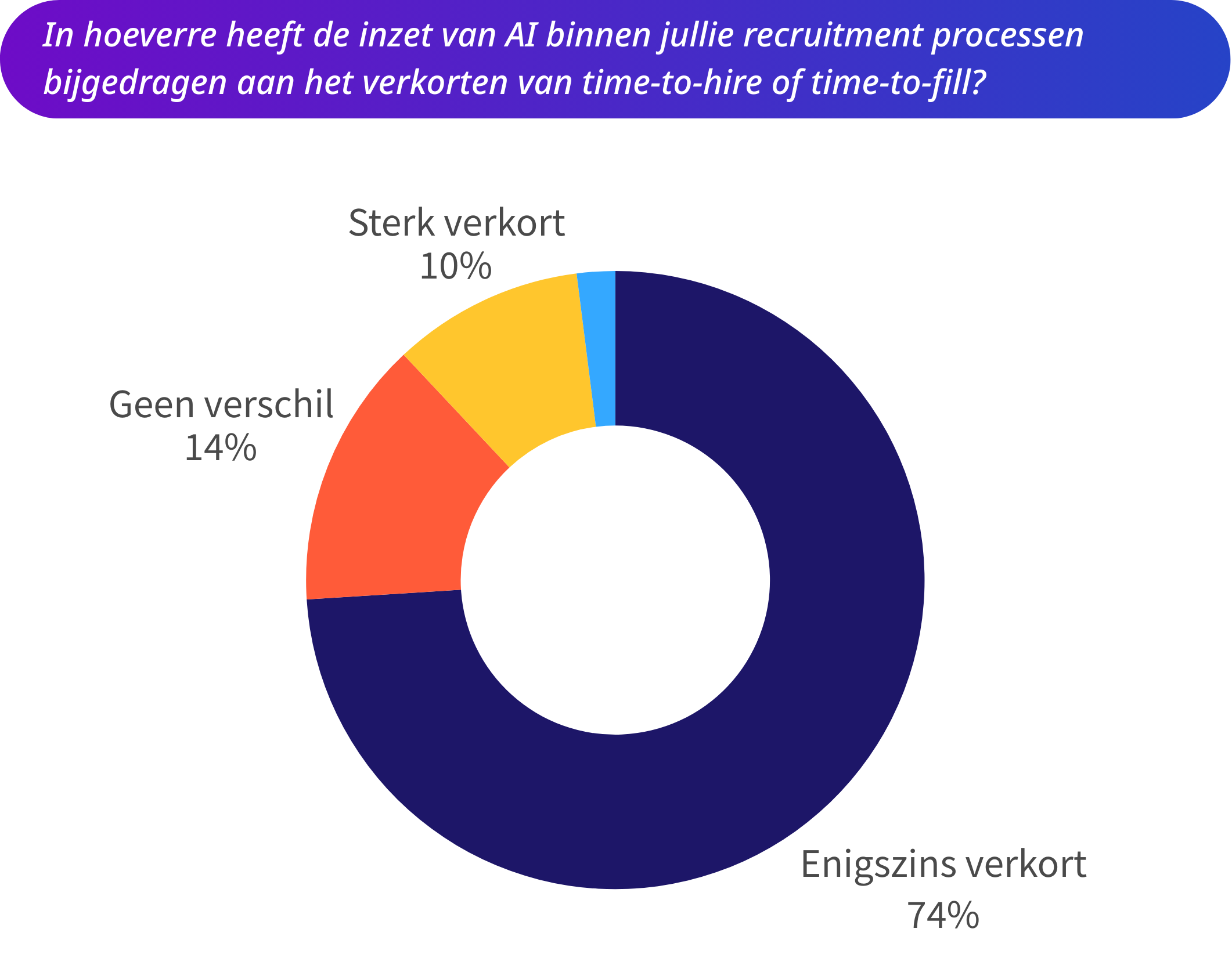
- With a time-to-fill of 39 days, staffing and recruitment agencies manage to fill vacancies faster than corporates (41 days) and SMEs+ (42 days). AI clearly contributes to this: 84% of recruitment consultants at staffing and recruitment agencies have seen recruitment speed increase due to the use of AI.
- Matching remains human work. Even though 50% of agencies are experimenting with AI matching, more than a third prefer to rely on in-house consultants rather than AI in this process.
The potential of AI for recruitment consultants
For many recruiters at a staffing or recruitment agency, it is clear where the biggest opportunity lies in the field of AI: matching candidates with vacancies. Almost 30% of recruitment consultants in this sector name this as the application with the most potential.
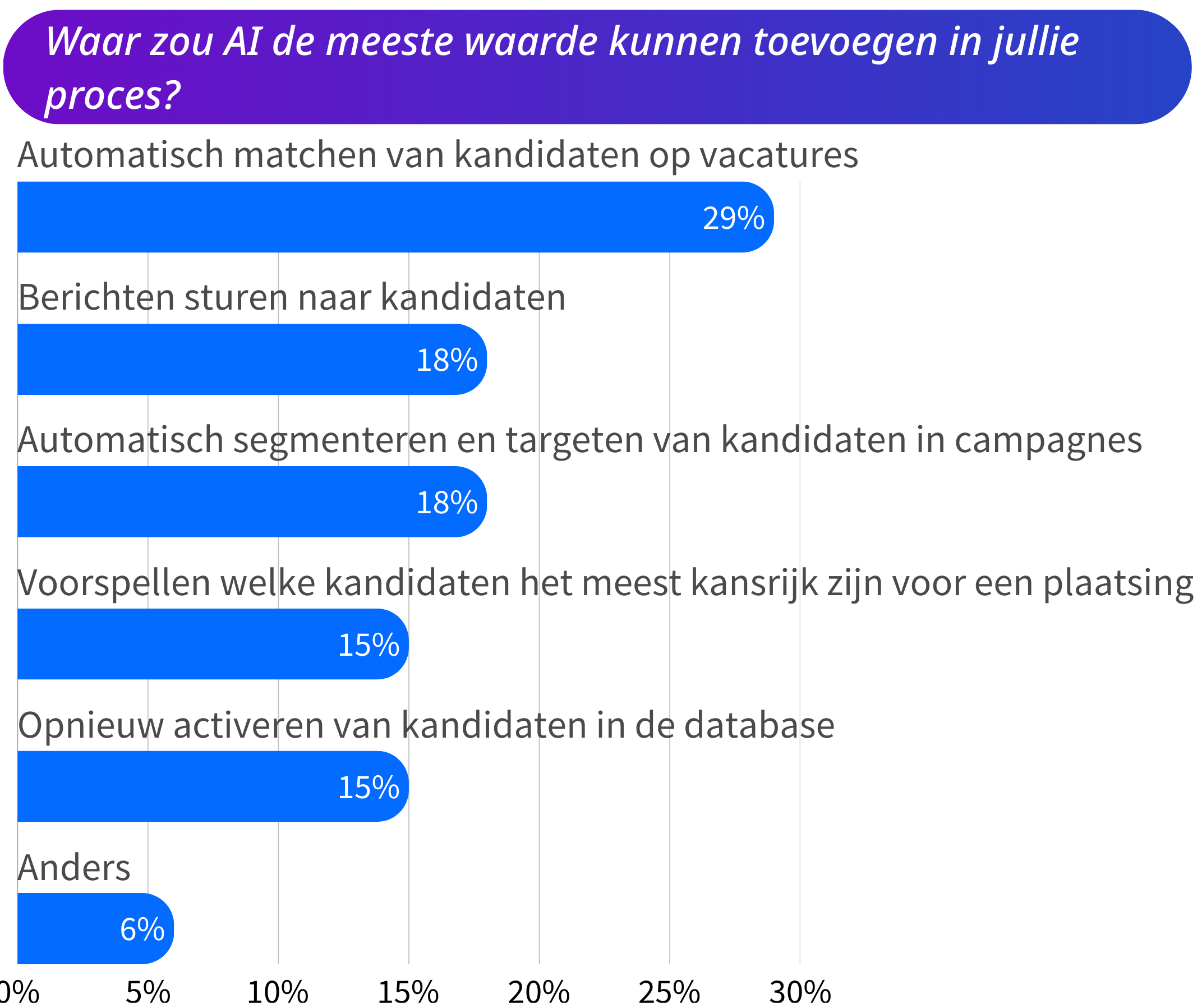
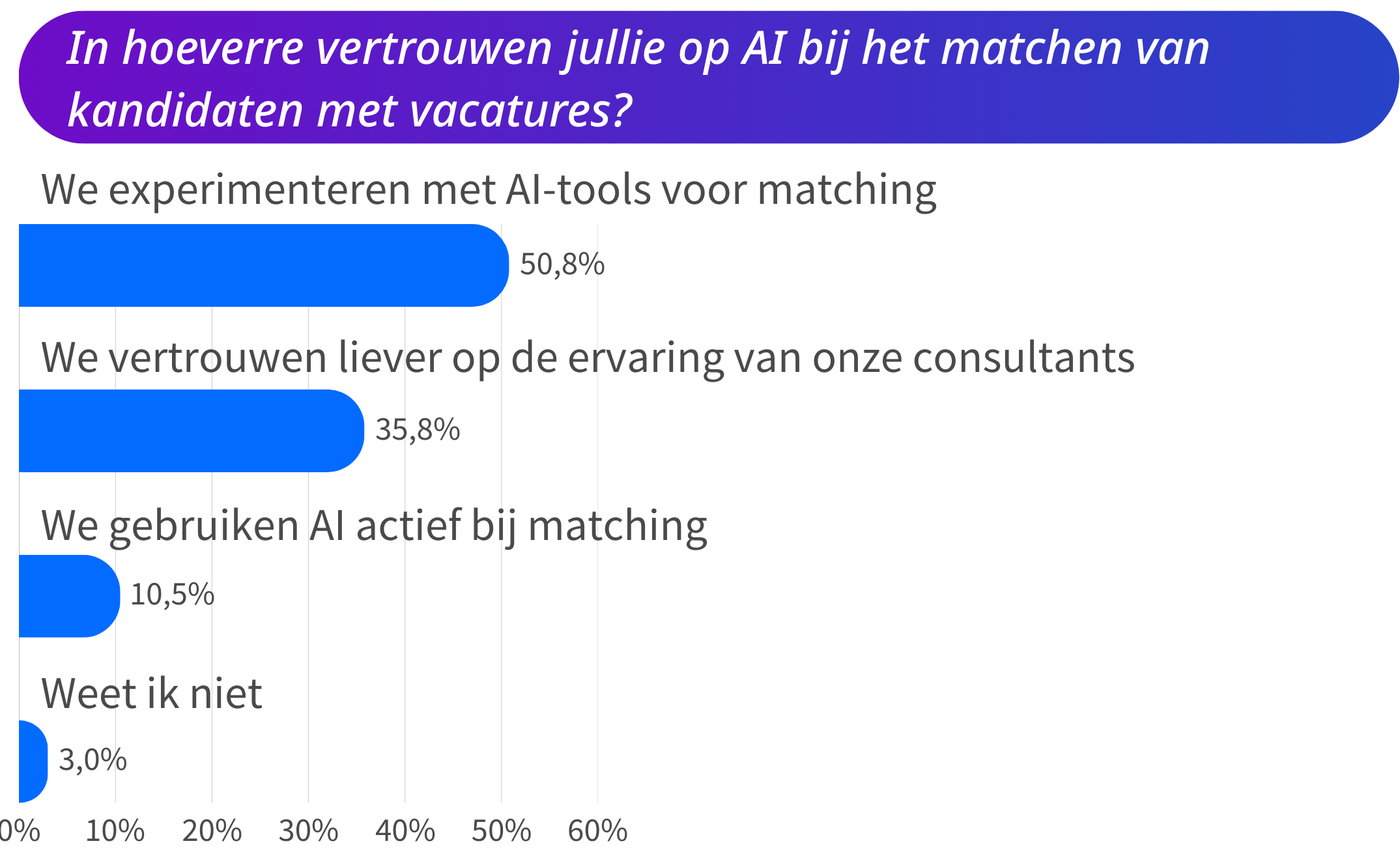
Many organisations have already taken steps to turn this opportunity into reality. More than 10% are structurally deploying AI-driven matching and half are experimenting with it. These include built-in AI matching within ATS systems like Carerix, Bullhorn, Teamtailor or Ubeeo, automatically scoring candidates based on skills and experience, or an external AI matching tool like Eightfold.
At the same time, people are critical of whether AI matching features are good enough to take over this task from recruiters. More than a third would rather rely on the expertise of recruitment consultants to match candidates to vacancies than on AI tech.
Staffing and recruitment agencies leading the way with AI and other recruitment tech
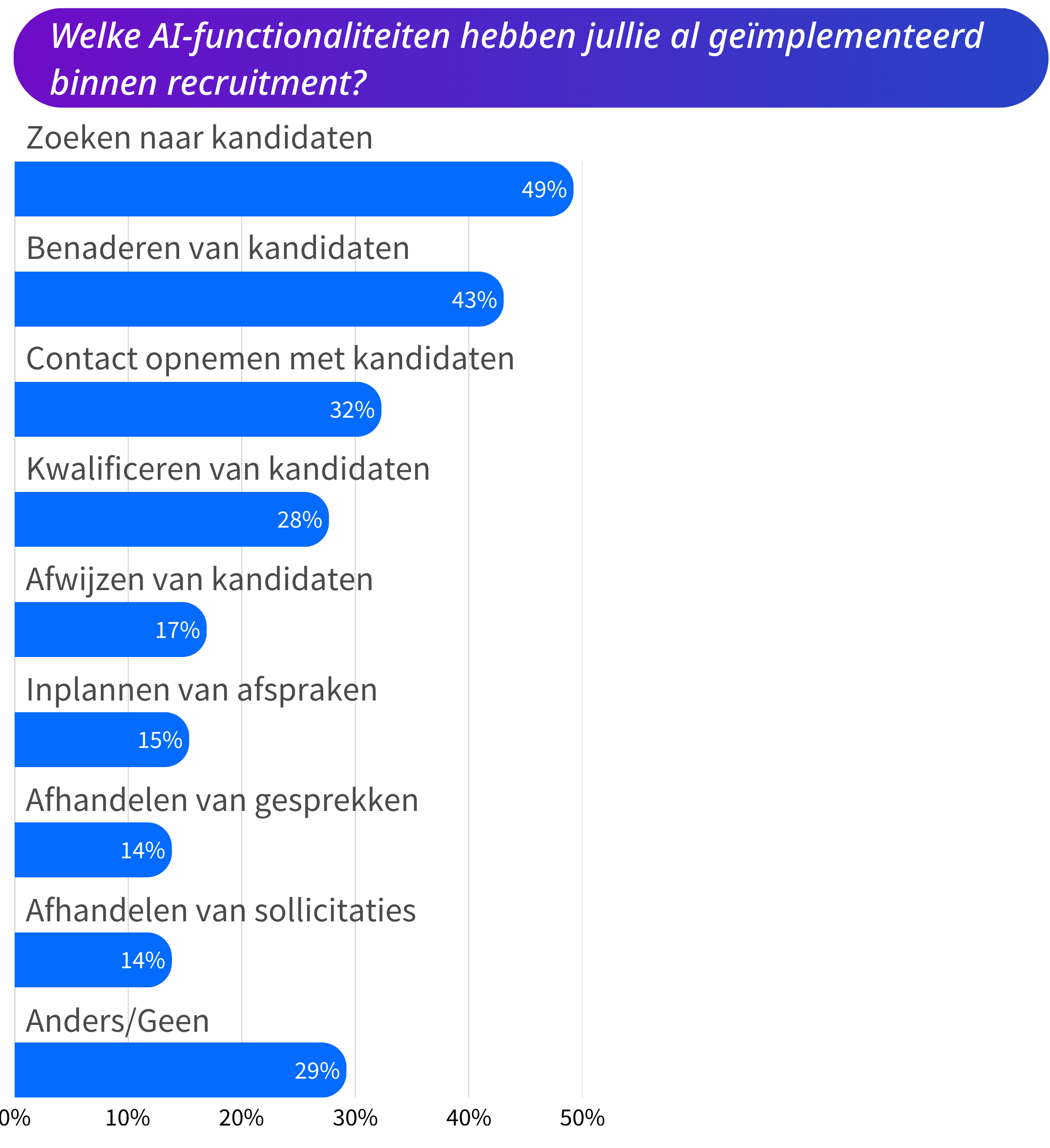
Due to the tight labour market, high competition and pressure on margins, staffing and recruitment agencies are constantly innovating and optimising. This is reflected in the figures: they deploy AI in recruitment more often than corporates and SMEs+. The most frequently used AI applications among staffers and agencies are:
- Candidate search (49% vs 33% of corporates + SMEs)
- Approaching candidates to capture their interest (43% vs 25% of corporates + SMEs)
- Contacting candidates after they have responded through a campaign, application, etc. (32% vs 19% of corporates + SMEs)
Other technologies that contribute to efficiency and an improved candidate experience are also being welcomed with open arms by recruitment agencies and staffing firms. 57% have partially or fully implemented recruitment marketing automation, whilst this figure stands at just 44% across the entire group of respondents (including corporates and SMEs) in the AI Trends Report.
Another striking difference compared with the overall report covering all sectors is how recruitment consultants at staffing and recruitment agencies view specific AI applications. For example, they see less value in having AI schedule interviews: only 5% cite this as an important application, compared with 10% when all respondents are included.
On the other hand, agencies are actually more positive about the role of AI in approaching candidates. 14 per cent see clear benefits here, whilst the figure in the AI Trends Report covering all sectors stands at 9 per cent. This difference is likely due to the fact that staffing and recruitment agencies are more involved in sourcing than recruitment professionals in SMEs and large corporations.
Recruitment and staffing agencies fill vacancies faster
Staffing and recruitment agencies' lead in recruitment technology is having a real impact: shorter time-to-fill. Whereas SMEs+ and corporates record an average time-to-fill of 41 and 42 days respectively, agencies and staffers manage to achieve a placement in 39 days. In an industry where every day counts, this is a significant difference.
It is clear that AI is contributing to this: 84% of recruitment consultants at staffing and recruitment agencies have seen recruitment speeds increase as a result of using AI. In the full MrWork AI Trends Report 2026, this figure stands at 78%.
Priorities and investment plans of recruitment agencies and staffers
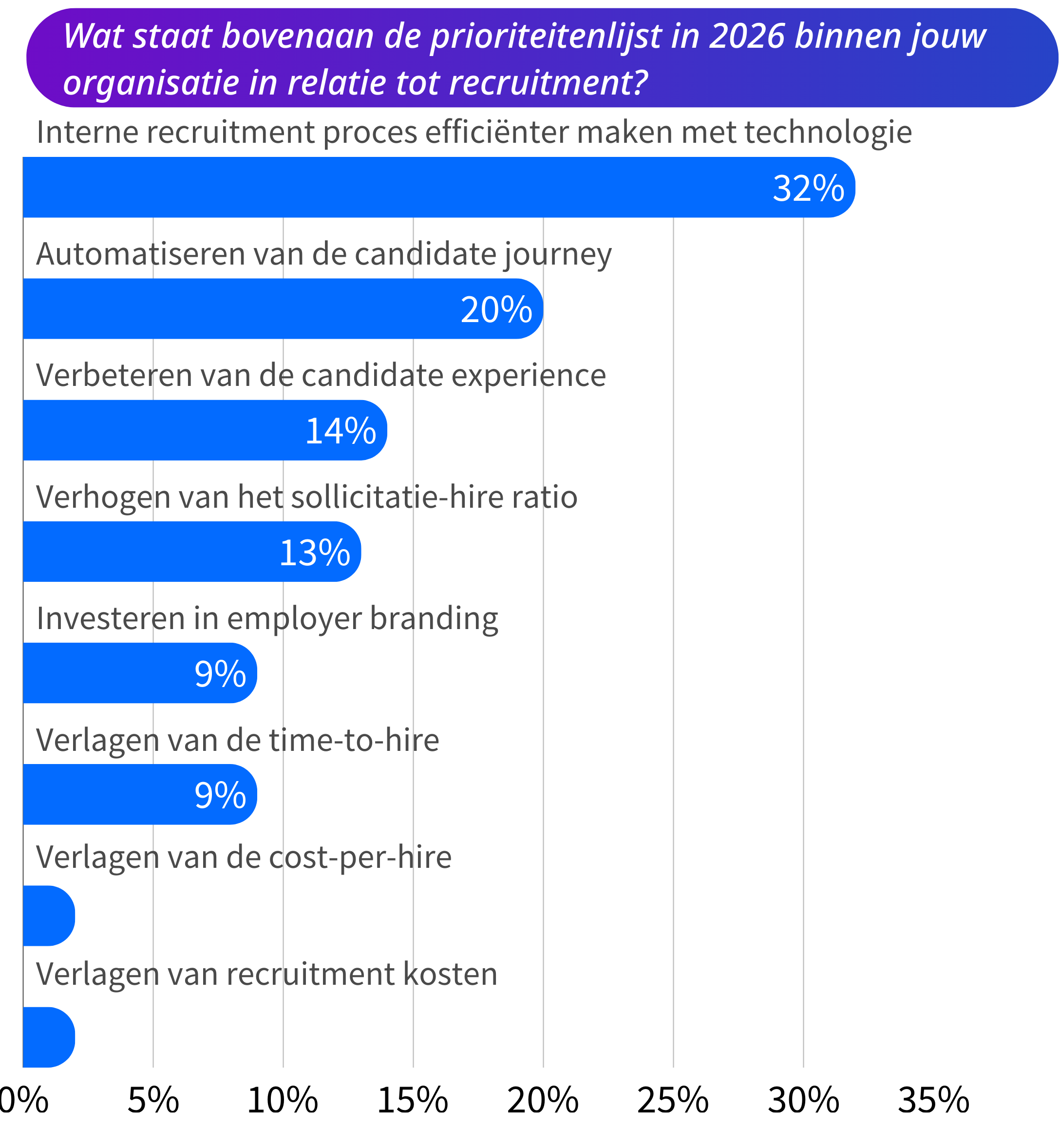
Making recruitment processes more efficient with the help of technology is priority number one. This is true for corporates, SMEs+ and staffing and recruitment organisations. But the latter group chooses the tech route even more emphatically than their peers, with 32% of staffing and agencies putting this topic at the top of their agenda, compared to 26% in the AI Trends Report (with corporates, SMEs+ and staffing).
These ambitions also translate into concrete investments. 60% of staffing and recruitment agencies will invest more in recruitment marketing automation in the coming year. With AI tech, the figure is as high as 84%. Thus, agencies are increasing their technological lead compared to direct employers. Among corporates, 52% will invest extra in RMA and 75% in AI, while within SME+ 51% and 77% respectively will invest more in these technologies.
Technology as accelerator, not replacement
The data leave little room for doubt: staffing and recruitment agencies are wholeheartedly opting for technological innovation. In a market where speed, quality and margins are under pressure, this is not a luxury but a necessity. Everything has to be faster and better. Agencies are therefore investing heavily in AI. At the same time, in many organisations it still remains a matter of separate experiments and tools that are not structurally embedded in the process.

"The impact of AI is still limited in many organisations because it is not structurally integrated into processes. Getting stuck in separate experiments with ChatGPT or other tools creates fragmented processes, unreliable data and frustration among recruiters."
Leon Buijsman, CEO Ubeeo and co-presenter of the podcast 'Successful Recruitment with AI'
The next step for staffing and recruitment agencies therefore lies not in yet another separate AI tool, but in structuring and integrating what is already there. Think of:
- AI matching directly linked to the ATS and actively used rather than just tested;
- Sourcing and outreach smartly supported by AI, with data flowing back to one central environment;
- Talent pools that do not get dusty, but are permanently activated via AI-driven flows;
- Smart AI agents that don't just make calls, but understand processes, perform follow-up actions and are continuously trainable.
Recruitment consultants who have already taken this step find that AI not only saves time, but above all creates calm and overview. Technology takes over repetitive work and makes room for where agencies really add value: personal contact with candidates and clients.
Thus, AI will not be a replacement for the recruiter, but an accelerator of growth.
Extra depth
Read more about recruitment in 2026
Research statement
This report is based on a questionnaire consisting of 25 questions. Some questions allowed respondents to give multiple answers, so the graphs do not always add up to 100%.
A total of 304 respondents, working in recruitment (marketing) in Belgium or the Netherlands, completed the questionnaire. In the MrWork AI Trends Report 2026, we identify three organisational segments:
- Corporate companies - organisations with 500 employees or more (45.5%)
- SME(+) - organisations up to 500 employees (25.7%)
- Recruitment agencies and staffing organisations (28.8%)
In this report specifically for staffing and recruitment agencies, we have compared data from respondents from the staffing sector with those from corporate companies and SMEs.
More inspiration?

We have more interesting things for you
Discover how recruitment marketing automation helps you independently recruit more and better candidates. Unlock the demo videos!

-
Health care and welfare
Large organisations
1000+ FTE
QuaRijn
QuaRijn achieves a stable intake through a sharp employer brand, a new work-at-home site and the MrWork AI Agent.


-
12.11.2026
On-demand webinar: Staffing Trends 2027: AI for staffing and recruitment agencies
Discover the AI trends for 2027 for staffing and recruitment agencies. Learn how to follow up more effectively and achieve immediate results.